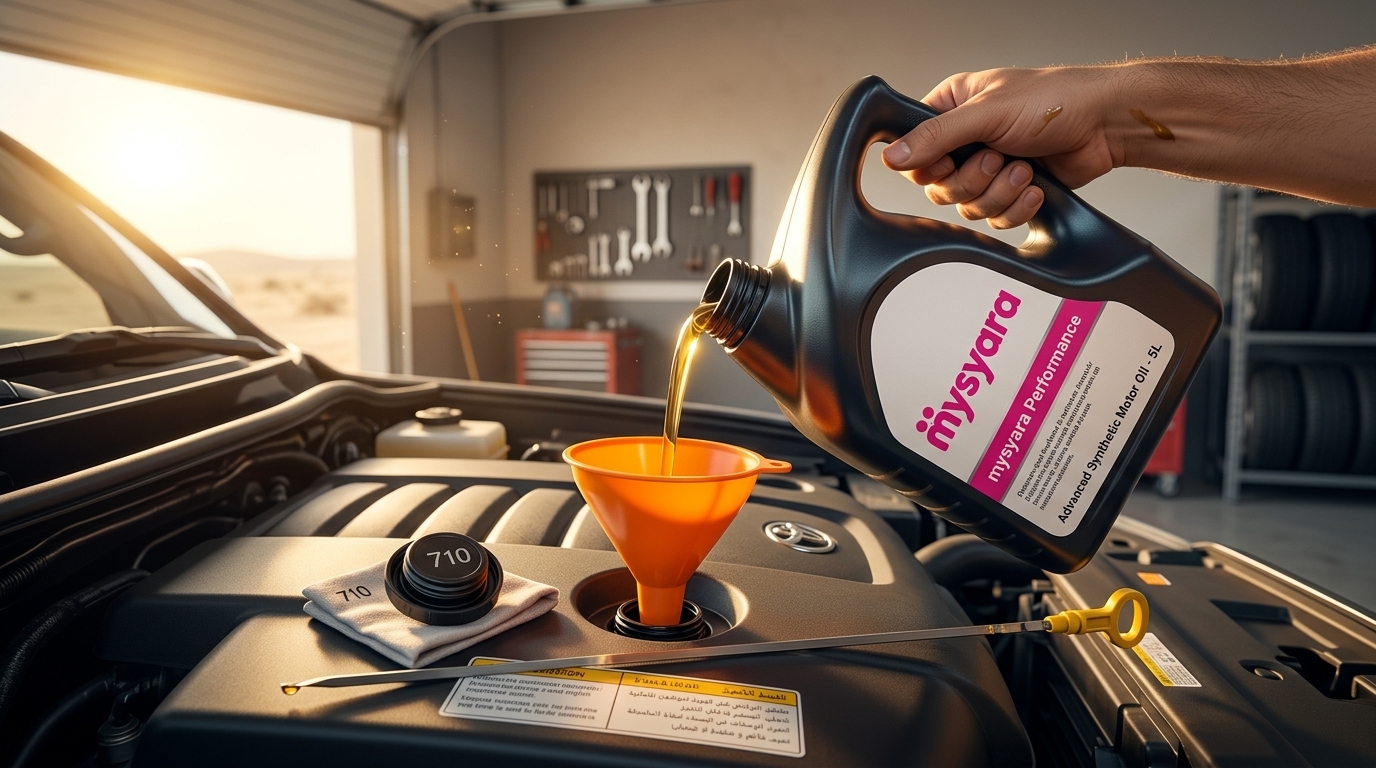
You have checked the dipstick, the oil is at or below MIN, and now you want to add some without making things worse. This guide picks up from there, practical and direct. The actual task is simple, but two mistakes ruin it: adding the wrong-spec oil, and adding too much. This article covers both.
One condition before you open anything: the engine must be warm (not hot), switched off, and the car parked on level ground. Warm means five to ten minutes after a short drive, enough for oil in the upper galleries to drain back to the sump so the dipstick reads accurately, but not so recently switched off that the filler cap area is scalding. In UAE summer, fifteen minutes after a long run is safer. On a cold engine, some oil stays held up in the valve cover and timing galleries, which can make the dipstick read falsely low and lead you to over-add. Do not remove the filler cap on a running engine: the oil system is pressurised and the cap area will splatter.
Level ground matters too. A two to three degree slope, barely noticeable, is enough to pool oil to one end of the sump and skew the dipstick reading by several millimetres. The average car park floor is good; a sloped driveway is not.
Key Takeaways
Always top up with the same SAE grade and OEM approval spec as the existing fill, a spec mismatch (not just a brand mismatch) is the real risk, especially in DPF- and GPF-equipped cars.
Add oil in 200–300 ml increments, wait one minute between each, and recheck the dipstick, overfilling is worse than running slightly low.
Topping up does not reset your oil change interval, the oil already in the engine degrades on its own schedule regardless of what you add.
A healthy modern engine should need little or no top-up between services; 1 L or more per 1,000 km is excessive and points to worn rings, valve stem seals, a PCV fault, or a turbo seal.
If the oil on the dipstick is milky or creamy, stop driving, that is coolant mixing with oil, almost certainly a head-gasket failure, and no amount of topping up corrects it.
Top-Up or Oil Change, Which Do You Actually Need?
A top-up adds volume; it does not replace old oil. If the level is low, topping up brings it back to the safe operating range. That is the right response to a low reading, but the clock on your next oil change does not move.
The oil already in the sump continues degrading on its own chemistry schedule. Detergent additives accumulate combustion by-products. The base oil oxidises. Antiwear and viscosity-improver packages break down. Adding 500 ml of fresh oil into 4 litres of old oil does not refresh the old oil; the freshness clock is the change date, not the level. Keep topping up only within the same oil-change cycle, if you are consistently topping up a full litre or more between changes, that is a different conversation (see the consumption section below).
For the full picture on when an oil change is due in UAE conditions, heat, short trips, and severe-service intervals, see the engine oil change interval for UAE driving.
The Rule Nobody Tells You: Same Grade, Same Spec
This is the section that saves engines and kills warranties when people skip it.
Match the SAE grade
The grade, 5W-30, 0W-40, 10W-40, is printed on the filler cap on top of the engine, or in the owner's manual. If the cap is blank, check the most recent workshop receipt or search the car's make, model, year, and engine type online. In UAE heat, adding 10W-40 into a 5W-30 sump raises the operating viscosity away from what the engine is calibrated for. It is not catastrophic for a single small top-up, but it is not best practice. Match the grade.
For a full breakdown of which grade suits which engine and why 5W-30 versus 5W-40 matters in Gulf temperatures, the 5W-30 vs 5W-40 guide covers the viscosity question in full. For the synthetic-versus-mineral decision, see the synthetic vs mineral engine oil guide.
Match the OEM approval spec, this matters more than the brand
The grade is the blunt instrument; the OEM approval spec is the fine instrument. Two oils can both be labelled 5W-30, both be fully synthetic, both look identical on the shelf, and one can be entirely wrong for your engine.
Here is why, using two real examples common in UAE driveways:
BMW 320i (2017, N20 engine, Longlife-04): BMW LL-04 means ACEA C3, a low-SAPS formulation. The initials stand for sulphated ash, phosphorus, and sulphur. Low-SAPS oil is required for diesel particulate filters (DPF) and gasoline particulate filters (GPF); BMW N-series engines with DPFs require it. A forecourt 5W-30 labelled API SP is full-SAPS, it does not carry a BMW LL-04 approval. Pouring it into a LL-04-spec engine is not a one-off disaster, but repeated use gradually accelerates ash loading on the particulate filter, eventually triggering regeneration faults and a costly filter replacement or clean.
Mercedes GLE 350 (2020, GPF-equipped, MB 229.52): The older-generation GLE 350 petrol used MB 229.5, a full-SAPS spec, widely available, easy to grab from any parts shop. But GLE variants from 2018 onwards were fitted with gasoline particulate filters on GCC-market cars, and those engines require MB 229.52 (low-SAPS). Using 229.5 in a 229.52-spec engine repeats exactly the same ash-loading problem.
The full OEM approval hierarchy, when "approved" beats "meets," how to read the MB and VW portals, and why LL-04 ≠ LL-01, is covered in depth at engine oil approval specs for UAE cars. For a top-up, the key takeaway is this: read the label, find the OEM approval code, and match it.
The pinch rule, genuine emergencies only
If the oil is critically low and you have no correct-spec oil available: an ACEA C3 low-SAPS oil is a reasonable short-term bridge for most modern cars with particulate filters, and will not harm a non-DPF/GPF engine either. It does not cover every case, some engines have particular sensitivities, but for one small top-up to reach safety, C3 is the responsible floor. Get the correct-spec oil at the next stop and note the top-up in the service log. Frame this as exactly what it is: a bridge, not a solution.
How to Top Up Engine Oil: Step by Step
No tools required beyond a clean cloth and, optionally, a small funnel if the bottle nozzle is too wide for the filler neck. Total time: ten to fifteen minutes including waiting between increments.
Step 1, Park on level ground and switch off the engine.
Wait five to ten minutes after a short drive, or fifteen minutes after a long motorway run. Level ground is essential for an accurate dipstick read.
Step 2, Pop the bonnet and find the oil filler cap.
Look for the oil-droplet symbol, a stylised oil can, on the cam cover or valve cover at the top of the engine. Do not confuse it with the dipstick tube (thinner, with a coloured ring handle) or the coolant reservoir (labelled "COOLANT" or marked with a wavy-lines symbol). On most UAE cars, Camry, Patrol, Prado, Corolla, Civic, Altima, X5, the filler cap is centrally positioned and easy to see with the bonnet open.
Step 3, Check the dipstick before adding anything.
Pull the dipstick out, wipe it clean with a dry cloth, push it all the way back in, pull it out again, and hold it horizontally. Read where the oil film ends between MIN and MAX. This is the step the how to check your engine oil level guide covers in full detail, including the thermal-expansion caveat for UAE summer readings. You must know exactly how far below MAX you are before you pour a single drop.
Step 4, Choose the correct oil.
Match the SAE grade printed on the filler cap and the OEM spec from the owner's manual or a previous workshop receipt. If you are genuinely uncertain, browse engine oil at MySyara Shop by make and model, or call +971 4 549 0333.
Step 5, Add slowly in 200–300 ml increments.
Remove the filler cap, pour one increment carefully using the bottle's built-in nozzle or a clean funnel. Replace the cap after each increment.
Step 6, Wait one minute between increments.
The added oil needs to drain down through the oil galleries to the sump before the dipstick registers it accurately. Skipping the wait is the single most common cause of overfilling: the dipstick still shows low, you pour again, and you go past MAX.
Step 7, Recheck the dipstick after every increment.
Hold it horizontally. Read where the oil film ends. You are looking for the upper half of the MIN–MAX zone.
Step 8, Stop when the level sits in the upper half of the safe range.
You do not need to hit MAX exactly, the upper half of the MIN–MAX band is the target. Chasing the MAX line precisely is where overfills happen.
Step 9, Replace the filler cap firmly.
Twist until it clicks or feels snug. A loose cap allows oil mist to escape onto hot engine surfaces and creates smoke and smell under the bonnet.
Step 10, Note how much you added and the date.
One line in the glovebox or a notes app. This is the data that tells you over time whether consumption is stable or growing.
Why Overfilling Is Worse Than Being Slightly Low
Most drivers know that low oil is bad. Fewer understand that too much oil is also genuinely harmful, and that the harm from overfilling can arrive faster than the harm from running slightly low.
The crankshaft rotates at 700 to 4,000 rpm inside the lower engine. When the oil level is too high, the crankshaft's counterweights and rod journals dip into the oil surface. At those speeds, this whips oil into aerated foam. Foam is compressible; pure oil is not. An oil pump cannot build stable pressure from foam, which means the engine loses its protective oil film under load, precisely when it is most needed, even while the oil-pressure warning light may show normal at low rpm.
Excess oil also raises crankcase pressure. Oil pushes past the front and rear main seals (expensive to replace), the valve cover gasket, and the PCV (positive crankcase ventilation) system. Oil entering the intake through the PCV creates carbon deposits in the intake ports and, in the worst case, oil in the combustion chamber, which fouls injectors and damages catalytic converters.
On many modern direct-injection petrol engines, common among the 2018-and-newer European and Korean models on UAE roads, overfilling by as little as half a litre can trigger a crankcase pressure fault code and push the engine into limp mode. The ECU interprets elevated crankcase pressure signals as a fault worth restricting power over.
If you overfill:
Do not drive further than necessary.
More than roughly five millimetres above MAX on the dipstick: drain via the sump drain plug or extract through the dipstick tube with an oil-extraction pump. A workshop can handle this in a few minutes. MySyara Shop's fitment service covers a drain-and-correct-refill, from AED 25 (plus oil and filter cost).
One to two millimetres above MAX: monitor it with a check twenty-four hours later; the level may settle slightly as oil redistributes.
Do not attempt to "drive it off." Oil does not evaporate or burn in meaningful quantities during normal driving. The excess stays until it is physically removed.
Reading the Signals: When Top-Ups Mean Something Bigger
Ramesh drives a 2015 Toyota Camry with 180,000 km on the clock. He has tracked his oil consumption for two years: the car uses around 400 ml per 5,000 km. He keeps a litre of the correct 5W-30 (API SP) in the boot and tops up midway through each oil-change cycle. His tracking shows it is stable, the same 400 ml, cycle after cycle. He is not worried; he is informed. The difference matters.
An engine that needs a small, predictable top-up is different from one whose consumption is rising. Here is how to read the signal by engine type:
Engine type
Acceptable consumption
Note
Modern naturally aspirated (e.g. Toyota 2AR, Honda K24)
0–0.3 L per 1,000 km
A healthy NA engine rarely needs a mid-cycle top-up
Turbocharged (e.g. VW EA888, BMW N20/N55, Audi 2.0 TSI)
0.3–0.5 L per 1,000 km
Turbo oil feeds the bearings; some consumption is normal
High-mileage (150,000+ km, any type)
0.5–1 L per 1,000 km
Acceptable if stable; monitor to confirm it does not climb
BMW N20/N55/S55 (BMW's published tolerance)
Up to 1 L per 1,000 km
BMW's own factory guideline, notable, worth flagging
Thresholds that mean book a workshop, not buy more oil:
1 L or more per 1,000 km on any modern engine that is not a BMW N-series with published tolerance: excessive. Likely causes, worn piston rings (oil burning from below the crown), valve stem seals (blue smoke on cold start or deceleration), PCV system failure (oil ingested into intake), or turbocharger seal failure.
Sudden change from stable to rising consumption: more concerning than a stable high rate. A Camry that has used 0.3 L/1,000 km for three years and suddenly shifts to 0.8 L/1,000 km warrants investigation sooner than a high-mileage diesel that has been steady at 0.5 L for years.
Blue smoke from the exhaust, especially on cold start or when lifting off the throttle: valve stem seals or piston rings. Oil is reaching the combustion chamber.
Milky or mustard-coloured oil on the dipstick or the underside of the filler cap: coolant is mixing with oil. A classic head-gasket failure sign. Stop driving immediately, this is not a top-up situation. Driving even tens of kilometres with coolant in the oil will score the crankshaft bearings. This is a recovery-to-workshop situation.
Oil level rising without any addition: fuel dilution or coolant ingress. Either is serious and needs diagnosis, not more oil.
If you are topping up more than 0.5 L per change interval on a healthy modern car, the top-up is bridging a gap that a workshop inspection needs to close. MySyara Shop's fitment teams can carry out a diagnostic appointment at UAE locations, not a standard fitment job; a proper inspection. Call +971 4 549 0333 to arrange it.
What Not to Mix
Keep this list visible when you are standing at the parts shelf:
Petrol-spec oil into a diesel sump (or vice versa). Diesel oil carries extra alkalinity to neutralise the acid load from diesel combustion. Petrol oil does not. The reverse, diesel oil into a petrol engine, is less immediately harmful, but it is not a habit to build.
Full-SAPS oil into a low-SAPS (DPF or GPF) engine as anything more than a one-off get-you-home top-up. The phosphorus and sulphur compounds in full-SAPS oil accumulate on the particulate filter substrate and damage it over time.
Oils of wildly different viscosity grades, for instance, topping a 5W-30 sump with 20W-50. The bulk viscosity of the combined fill shifts enough to affect cold-start protection and operating-temperature film thickness.
Long-drain extended-life chemistry on top of standard short-drain oil. The drain interval should be set by the original fill, not the top-up. One increment of a long-drain oil does not extend the change interval.
Old-spec API SL or SM oil into a modern direct-injection petrol engine. Modern GDI engines accumulate LSPI (low-speed pre-ignition) risk; API SN Plus, SP, or SQ are required for LSPI protection. Older spec oil from an uncleared shelf lacks it.
A small top-up of correct-spec oil from a different reputable brand is not a chemical risk. Additive packs within the same ACEA or OEM spec class are designed to be compatible. The brand is not the variable to worry about; the spec is.
Which Brands Work for a Top-Up?
The right brand is the one that carries the correct OEM approval or ACEA grade for your engine, at the correct viscosity. Named examples at MySyara Shop:
For BMW LL-04-spec engines (ACEA C3 low-SAPS): Mobil 1 ESP Formula 5W-30 carries a BMW Longlife-04 approval; Shell Helix Ultra Professional AF 5W-30 is another LL-04-approved option. Check the label, "BMW Longlife-04" must appear explicitly. A bottle that only states API SP without an LL-04 listing is not the same product, even at the same viscosity.
For Mercedes 229.51 / 229.52 (low-SAPS):Motul-specific MB 229.52 products are a non-tie-up option at the same spec tier. Mobil 1 ESP 5W-30 and Shell Helix Ultra Professional AG also carry 229.52 approval, check the live MB portal with your VIN to confirm currency.
For Toyota/Honda API SP or ILSAC GF-6 engines (most Camry, Corolla, Civic, CR-V, Accord): Caltex Havoline and Mannol both cover common Japanese-car grades at accessible price points. Red Line covers high-performance grades for modified or track-used engines.
These are stocked examples, not a ranking. Within a given OEM approval, brands perform comparably. The specification on the label is the decision criterion; the brand is a tiebreaker, not the primary choice.
Khalid bought a used 2017 BMW 320i six months ago. The previous owner's service history confirms the correct Longlife-04 oil was used throughout. After his first 3,000 km, the level dropped to just above MIN. He asked at a petrol station forecourt and was handed a 5W-30 bottle with "API SP" on the back. He almost used it.
The label on the BMW's filler cap reads "Longlife-04 approved." The API SP bottle does not list BMW Longlife-04 anywhere on it, it is full-SAPS, ACEA A3/B4 chemistry. It would have met the viscosity requirement and not caused instant damage. But BMW's LL-04 requirement exists because the N20 engine's particulate filter requires low-SAPS chemistry, and repeated top-ups with the wrong spec gradually accelerates ash loading.
Khalid ordered the correct oil from MySyara Shop and did the top-up at home, ten minutes, two increments of 250 ml each, one-minute wait between them. The difference on the bottle: the LL-04-approved 5W-30 shows "BMW Longlife-04" on the label. The API SP bottle does not.
UAE-Specific Notes
Heat and oil evaporation: oil loss from evaporation in UAE summer is real but marginal on a well-sealed modern engine. It is not an explanation for monthly top-ups. The main UAE-specific factor on consumption is oxidation rate, the base oil and additive pack break down faster above 40°C ambient, which shortens change intervals but does not meaningfully increase consumption between intervals on a healthy engine. Follow the severe-service change schedule (see engine oil change interval for UAE driving); do not use the heat as a reason to add more oil more often.
Short-trip fuel dilution: UAE city driving, the school run, the five-minute hop between malls, queuing into Deira with AC on maximum, involves many trips where the engine never fully reaches operating temperature. Petrol can condense in the oil during warm-up phases, thinning it slightly over time (fuel dilution). This shows up as an oily smell of petrol on the dipstick, and it is a reason to follow the shorter severe-service change interval. It is not a reason to add more oil, fuel dilution does not reduce oil level, it degrades the oil chemistry.
Expat service delays: a common pattern among longer-term UAE residents is extending service intervals during summer because workshops are busy, it is hot, and the drive feels inconvenient. This is precisely when change intervals should not be stretched, heat accelerates oil degradation, not the other way around. If a top-up is needed because the car is running long past its change interval, the answer is a booking, not another bottle.
Fitment and Oil Change, When to Stop DIYing
Two clear scenarios, two honest answers:
The gap before a scheduled change: you are topping up 300 ml and the oil change is due within the next 1,000 to 2,000 km. Top up, drive normally, book the change. Browse engine oil at MySyara Shop for the correct grade and spec to have ready. MySyara Shop fits oil changes from AED 25 (plus the cost of oil and filter), a full oil change at that interval is the right move, not a second top-up.
Consumption is the real problem: you are topping up a litre every 2,000 km and it is not stabilising. The honest answer is that the top-up is bridging a diagnostic gap, not solving it. Do not spend money on bottles when what the car needs is a ring, seal, PCV, or turbo inspection. Call +971 4 549 0333 to arrange a diagnostic appointment. Fitment locations: Al Quoz Industrial 3 (Dubai), Umm Ramool/Rashidiya (Dubai), Wadi Al Amardi (Dubai), and Rawda 1 (Ajman).
No emergency framing here, scheduled, planned, calm. The goal is to stop guessing and start knowing what is happening inside the engine.
Frequently Asked Questions
Can I mix 5W-30 with 5W-40 for a top-up?
As a one-off in the same sump, yes, the chemistry is compatible and the resulting viscosity will sit between the two grades. It is not a problem for a short period. But always aim to match the grade your manual specifies. If 5W-30 is unavailable and 5W-40 is the closest correct-spec option, one top-up is fine, correct it at the next oil change.
What if I accidentally overfill?
Do not panic and do not drive more than necessary. A few millimetres above MAX on the dipstick is borderline, monitor it at the next check twenty-four hours later. More than five to ten millimetres above MAX is worth addressing promptly: drain via the sump plug or use an oil extraction pump through the dipstick tube. A workshop can drain the excess in minutes. Do not "drive it off", oil does not evaporate in meaningful amounts during normal driving.
How much consumption is normal?
For a healthy naturally aspirated petrol engine: zero to 0.3 L per 1,000 km is ideal. Up to 0.5 L per 1,000 km is within the acceptable range for many turbocharged engines. BMW publishes a factory tolerance of up to 1 L per 1,000 km for some N-series engines, notable and worth knowing for those owners. Above 1 L per 1,000 km on any modern engine that does not carry that specific BMW tolerance is a signal to book a workshop inspection.
Is it safe to top up with a different brand?
Yes, provided the grade and OEM approval spec match. Oil chemistry within the same spec class, all ACEA C3 oils, or all BMW LL-04-approved oils, is designed to be compatible across brands. What you must not mix is the spec class: a full-SAPS oil from a premium brand added to an ACEA C3 low-SAPS engine is still a spec mismatch, regardless of how reputable the brand is.
Can I keep topping up forever instead of changing the oil?
No. Topping up maintains the oil level; it does not refresh the oil. The additives degrade, the detergent capacity fills with combustion by-products, and the base oil oxidises, regardless of whether you have kept the level at MAX throughout the interval. Oil changes are timed to the chemistry lifecycle, not the volume. Top-ups buy you kilometres within a cycle; they do not extend the cycle.
Should I top up at the petrol station or wait until I get home?
If the oil is at MIN or below, top up as soon as you can, driving on critically low oil risks bearing damage. If you are slightly below the midpoint and have a few kilometres home, it is safe to wait. The risk of a forecourt top-up, wrong spec, wrong grade, time pressure, is real. Getting it right at home, where you can take your time and recheck the dipstick, is better. Keep a 500 ml bottle of the correct-spec oil in the boot, a sensible UAE precaution in a hot climate where oil demands more of itself than it does in a temperate one.
Ready to top up or overdue for an oil change?Browse engine oil and lubricants at MySyara Shop, fully synthetic, semi-synthetic, and mineral grades from Mobil 1, Shell, Caltex, Motul, Mannol, Formula 1, and Red Line, covering the grades and specs for the majority of cars on UAE roads. Prefer to have the oil change handled? MySyara Shop fits it from AED 25 (plus oil and filter). Call +971 4 549 0333 to arrange fitment at a UAE workshop location convenient to you.
Free UAE delivery on orders over AED 200UAE fitment available from AED 25Genuine parts backed by warrantyShips worldwide from Sharjah