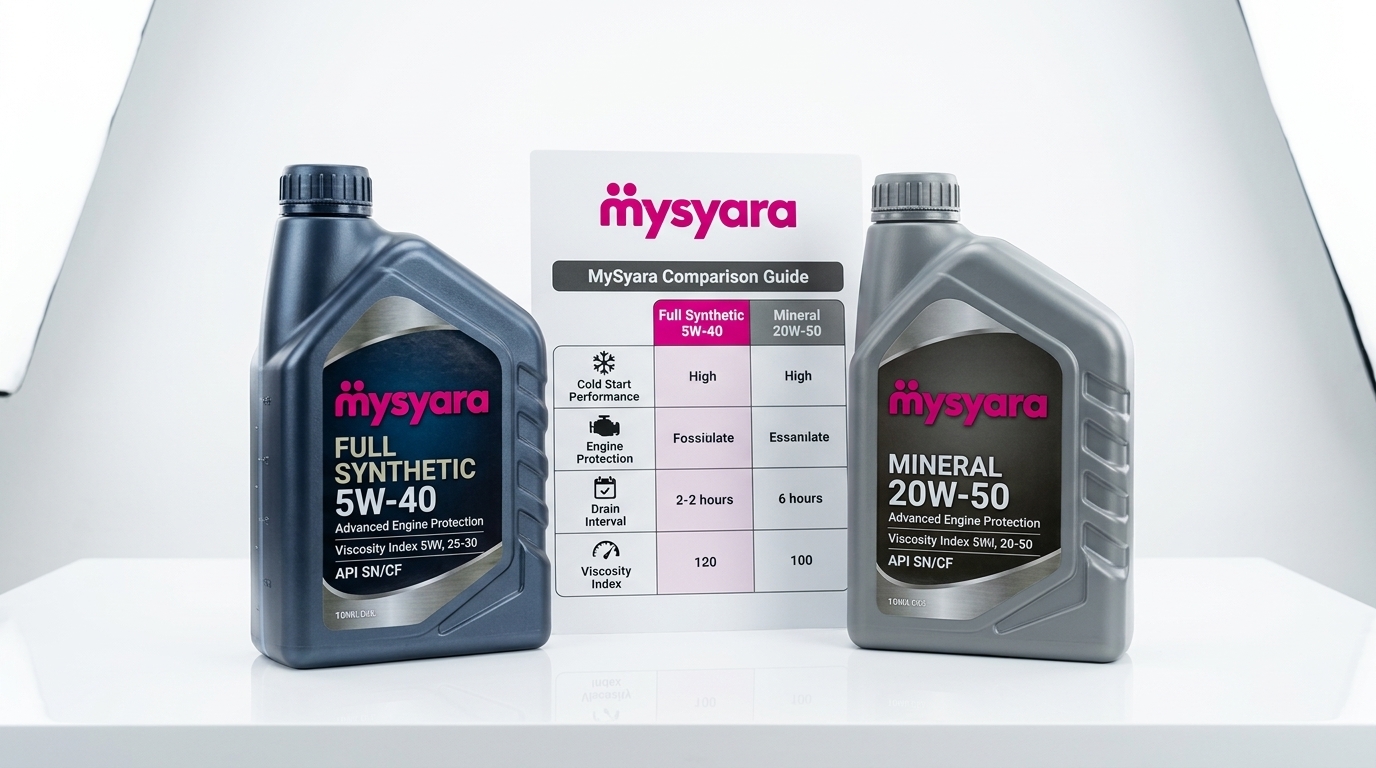
Synthetic vs Mineral Engine Oil: Which Should You Use? (UAE)
Published 24 May 2026•10 min read
For most modern cars sold in the UAE, the answer is fully synthetic: it handles the heat better, lasts longer between changes, and protects the engine more reliably in stop-start Dubai traffic. But the final word is always your owner's manual. If it specifies mineral oil, mineral oil is correct for that engine. The type of oil and the grade (5W-30 vs 5W-40) are two separate questions; this article covers the type.
Key Takeaways
Three types exist: mineral (conventional), semi-synthetic (blend), and fully synthetic. Each is a different base oil chemistry, not just a marketing tier.
The API rating on the label (SP, SN, etc.) tells you the performance standard, not the base oil type. A bottle labelled "API SP" could be mineral, semi-synthetic, or fully synthetic.
In UAE heat, fully synthetic resists thermal breakdown longer; mineral oil degrades faster at high temperatures and needs changing every 5,000 km.
Your owner's manual specifies the type and grade your engine was designed for. Check it before upgrading or switching.
Switching from mineral to synthetic is safe on most modern engines; on high-mileage older cars, read the cautions in the "Can I switch?" section below.
The Three Types in Plain English
Mineral oil is the traditional form, refined directly from crude oil. It goes through a distillation and purification process, but the base molecules are still a natural mix of different hydrocarbon shapes and sizes. Think of it as cleaned-up crude: functional, economical, but inconsistent at a molecular level. According to the Wikipedia motor oil article, mineral oils use Group I and Group II base stocks, the most basic refinery outputs.
Semi-synthetic oil (also called synthetic blend) is a mixture of mineral base oil and some proportion of synthetic base oil. There is no fixed regulatory definition for how much synthetic it must contain; it could be 25% synthetic or 40%, depending on the manufacturer. The blend gives better performance than pure mineral oil at a lower price than full synthetic. It is a genuine middle option, not just a marketing label.
Fully synthetic oil is engineered from the ground up. The dominant base stock is a compound called PAO (polyalphaolefin), a Group IV base oil built by chemically joining smaller molecules into a uniform, purpose-built chain. Because the molecules are consistent in size and shape, they flow more predictably, resist breaking down at high temperatures, and cling to metal surfaces more evenly. Premium full synthetics also blend in Group V esters, which help dissolve additives and handle extreme loads.
One thing that confuses many buyers: the API rating is not the base oil type. A bottle showing "API SP Fully Synthetic" and a bottle showing "API SP Conventional" carry the same performance standard; the chemistry inside is completely different. The API rating tells you the engine-protection quality level (API SP being the current highest for petrol engines, introduced in 2020). The words "fully synthetic" or "mineral" tell you what the base oil is. Both matter; they are different labels.
Once you know the type and grade your car needs, search the engine oil range at MySyara Shop to filter by type and grade.
Synthetic vs Mineral Engine Oil: Side by Side
Mineral
Semi-Synthetic
Fully Synthetic
Base oil chemistry
Group I/II refined crude
Group I/II + Group III/IV blend
Group IV PAO (and V esters)
Change interval (UAE)
5,000 km
7,000-8,000 km
10,000-15,000 km (most UAE workshops use 10,000 km)
Thermal stability in heat
Moderate; thins and oxidises faster at 45°C+
Better than mineral; limited by the mineral fraction
Best; engineered to hold viscosity at extreme temperatures
Sludge resistance
Lower; breaks down faster under heat and short trips
Improved over mineral
High; resists oxidation and deposit formation
Best for
Older/simpler engines where OEM specifies mineral; very frequent service schedules
Modern cars where OEM allows a blend; budget-conscious drivers
Most modern cars, turbocharged engines, direct injection; UAE summer driving
Cost band
Budget
Mid
Mid-to-premium
OEM requirement
Only use if the manual says mineral or "conventional"
Only if the manual permits a blend
Required for turbo, DI, and most post-2010 European engines
Change intervals above are for UAE-condition driving (classified as "severe service" by most manufacturers due to heat, dust, and stop-start traffic). Intervals for milder climates are longer.
Why UAE Heat Tilts the Choice Toward Synthetic
Engine oil has one job: keep a thin protective film between moving metal parts so they never touch directly. Heat is the enemy of that film. As temperature rises, oil thins out. If it thins too much, the film breaks and metal touches metal.
In the UAE, ambient temperatures regularly reach 45°C in summer. Under a bonnet, with the engine running in slow traffic on the Sheikh Zayed Road in August, the oil sump temperature can be 20-30°C above that. Multiple UAE-based automotive guides note that the combination of extreme heat, dusty air, and frequent short trips causes engine oil to degrade 20-30% faster here than in cooler climates like northern Europe.
Mineral oil, with its inconsistent molecular structure, oxidises and loses its viscosity more quickly in this environment. Full synthetic oil, with its uniform PAO molecules, resists oxidation and holds its protective film longer. This is not a theoretical difference; it is the reason UAE driving is categorised as "severe service" by most manufacturers, and why the full-synthetic change interval is already shorter here (10,000 km is the practical UAE recommendation, not 15,000 km) compared to European highway driving.
That said, "synthetic is better" does not mean "mineral is dangerous." If your owner's manual specifies mineral oil, the engine was designed and tested with that oil. Changing it every 5,000 km keeps the protection adequate. The issue arises when drivers use mineral oil in an engine that requires synthetic, or stretch mineral-oil change intervals because they've heard synthetics "last 15,000 km" and apply that logic to the wrong oil type.
When Mineral Oil Still Makes Sense
Mineral oil is not obsolete. There are real scenarios where it is the right choice.
Older engines designed for mineral oil. Pre-2000 engines, and many simple naturally-aspirated engines from the early 2000s, were designed with wider internal tolerances that suit mineral oil's slightly thicker, less-uniform molecules. Using full synthetic in these engines is not harmful (modern synthetics are backward-compatible), but the OEM specified mineral for a reason.
Very high service frequency is acceptable. A fleet operator running four work vehicles, planned to the km, changes the oil on two older Hilux pickups every 4,500 km using a quality mineral oil. Over a 90,000 km span, the cost per km of mineral at 4,500 km intervals versus full synthetic at 10,000 km intervals is similar; the difference is the discipline required. For a fleet operator with a reliable service schedule, mineral oil at short intervals is a valid strategy.
Cost is a genuine constraint. Not every car owner can or should pay the premium for full synthetic. If the manual allows mineral and the service interval is followed, the engine will be adequately protected. The risk comes from skipping intervals, which is more likely when oil changes feel expensive.
When Semi-Synthetic Is the Right Middle Ground
Semi-synthetic oil suits the gap between "mineral is all my engine needs" and "my car requires the full protection of synthetic."
A practical example: a 2016 Nissan Patrol V8 whose manual allows either a quality mineral or a synthetic blend for normal use, recommending full synthetic only for severe conditions (sustained towing, very high mileage). With most driving being the daily Abu Dhabi-Al Ain commute and occasional off-road runs, a good semi-synthetic changed at 7,500 km works well; it costs less than full synthetic and makes it easier to keep on schedule than a synthetic-only interval tempts.
Where semi-synthetic does not belong: turbocharged engines, direct-injection petrol engines, and most post-2015 European cars. These engines generate higher heat at the top of the piston, and the mineral fraction in a semi-synthetic blend is the weak point under that load. For a 2020 BMW X5 (petrol turbo), the manual specifies a fully synthetic ACEA C3-rated oil. A semi-synthetic with the correct viscosity grade is not an acceptable substitute; it lacks the additive certification and the thermal stability the engine demands.
The rule: if your manual says "full synthetic" or lists an ACEA C2/C3 or BMW Longlife specification, use full synthetic. A semi-synthetic will not meet those specifications even if it carries the same viscosity grade.
Can I Switch from Mineral to Synthetic?
This is one of the most common questions on UAE car forums, and the answer is: generally yes, on a modern engine, at your next scheduled oil change.
Modern full synthetic oils are formulated to be compatible with engines that previously ran mineral oil. The switch does not require a "flush" or any special procedure beyond putting the new oil in with a fresh filter at a normal service interval.
The one genuine caution: high-mileage or older engines that have run mineral oil for many years may have sludge deposits around gaskets and seals. Synthetic oil has stronger detergent additives that clean the engine more aggressively. In a sludge-heavy engine, this cleaning action can expose micro-leaks in old gaskets that the sludge was previously sealing. The synthetic oil did not cause the leak; it revealed a pre-existing problem.
If your car has 150,000 km or more, has missed oil changes, or has visible sludge on the dipstick (dark, thick, almost tar-like), speak to a mechanic before switching. In most cases the engine is healthy enough to switch without drama; the advice is just not to do it blind on a very neglected engine.
For a well-maintained modern car (under 120,000 km, no missed services), the switch from mineral to full synthetic is straightforward. Use the same viscosity grade your manual specifies. Do it alongside a filter change. That's the complete process.
The Verdict for UAE Drivers
The synthetic vs mineral engine oil question most UAE car owners need to answer is this: if your car was made after roughly 2010, fully synthetic is the right type. Modern turbocharged, direct-injection, and variable-valve-timing engines require it; UAE heat makes the thermal-stability advantage meaningful; and the longer change interval (10,000 km vs 5,000 km) at least partially offsets the higher cost per litre.
For older naturally-aspirated engines where the manual specifies mineral, stay with mineral and change it at 5,000 km or less in UAE conditions. The discipline of short intervals matters more than the type of oil.
For the gap between the two, semi-synthetic is a genuine upgrade over mineral for cars where the manual allows a blend, particularly for daily commuters in the mid-price range.
In all cases: the type and grade in your owner's manual is the starting point. "Upgrading" to a heavier grade or a pricier type than the engine was designed for is not a free improvement. Match the spec, buy a quality oil from a brand that meets it, and change it on time.
Available at MySyara Shop: once you know the type and grade from your manual, Mobil 1 (full synthetic, wide API/ACEA coverage) and Shell Helix Ultra (full synthetic, also semi-synthetic in the HX7 range) are two well-stocked options. Caltex Havoline, Motul 8100, and Mannol cover the full range from mineral through to full synthetic across multiple viscosity grades.
The grade question (5W-30 vs 5W-40) is separate from the type question answered here. If you're also choosing between grades, see our 5W-30 vs 5W-40 comparison for UAE cars.
Ready to order?Browse engine oil and lubricants at MySyara Shop: mineral, semi-synthetic, and fully synthetic from Mobil, Shell, Caltex, Motul, Mannol and more. Prefer to have the oil changed rather than doing it yourself? MySyara Shop fits parts from AED 25; call +971 4 549 0333 to arrange fitment.
Frequently Asked Questions
Is synthetic oil worth it in the UAE?
The short answer on synthetic vs mineral engine oil for UAE drivers: yes, for most modern cars. The UAE's heat degrades oil faster than in cooler climates, and full synthetic holds its protective film longer between changes. The cost difference narrows when you account for fewer oil changes per year. For older engines where the manual specifies mineral, synthetic is not necessary; the discipline of changing mineral oil on time is what matters.
Can I use mineral oil in Dubai's summer heat?
Yes, if your owner's manual permits it. Mineral oil is adequate when changed at the correct interval (every 5,000 km or less in UAE conditions). The risk is not using it; the risk is stretching the interval because it seems fine.
What is semi-synthetic oil?
A blend of mineral base oil and synthetic base oil. There is no fixed legal definition for the ratio; it varies by brand and product. Semi-synthetic offers better heat resistance and longer change intervals than pure mineral (around 7,000-8,000 km in UAE use) at a lower price than full synthetic.
Can I switch from mineral to synthetic oil?
On most modern, well-maintained engines: yes, at the next scheduled oil change with a fresh filter. Use the same viscosity grade your manual specifies. On high-mileage or neglected engines with sludge build-up, check with a mechanic first; synthetic's cleaning action can reveal pre-existing seal wear.
Which oil does my car actually need?
Check the owner's manual (the lubrication section) or the sticker on the oil-filler cap under your bonnet. The manual specifies both the type (synthetic/mineral) and the grade (e.g., 5W-40). Any API or ACEA specification listed there must also be matched, not just the viscosity grade.
How often should I change engine oil in UAE conditions?
In the UAE, driving is classified as "severe service" by most manufacturers due to heat, dust, and stop-start traffic. Practical intervals: mineral at 5,000 km, semi-synthetic at 7,000-8,000 km, full synthetic at 10,000 km. Do not apply a European or North American interval (15,000 km for synthetic) without reducing it for UAE conditions.
Free UAE delivery on orders over AED 200UAE fitment available from AED 25Genuine parts backed by warrantyShips worldwide from Sharjah