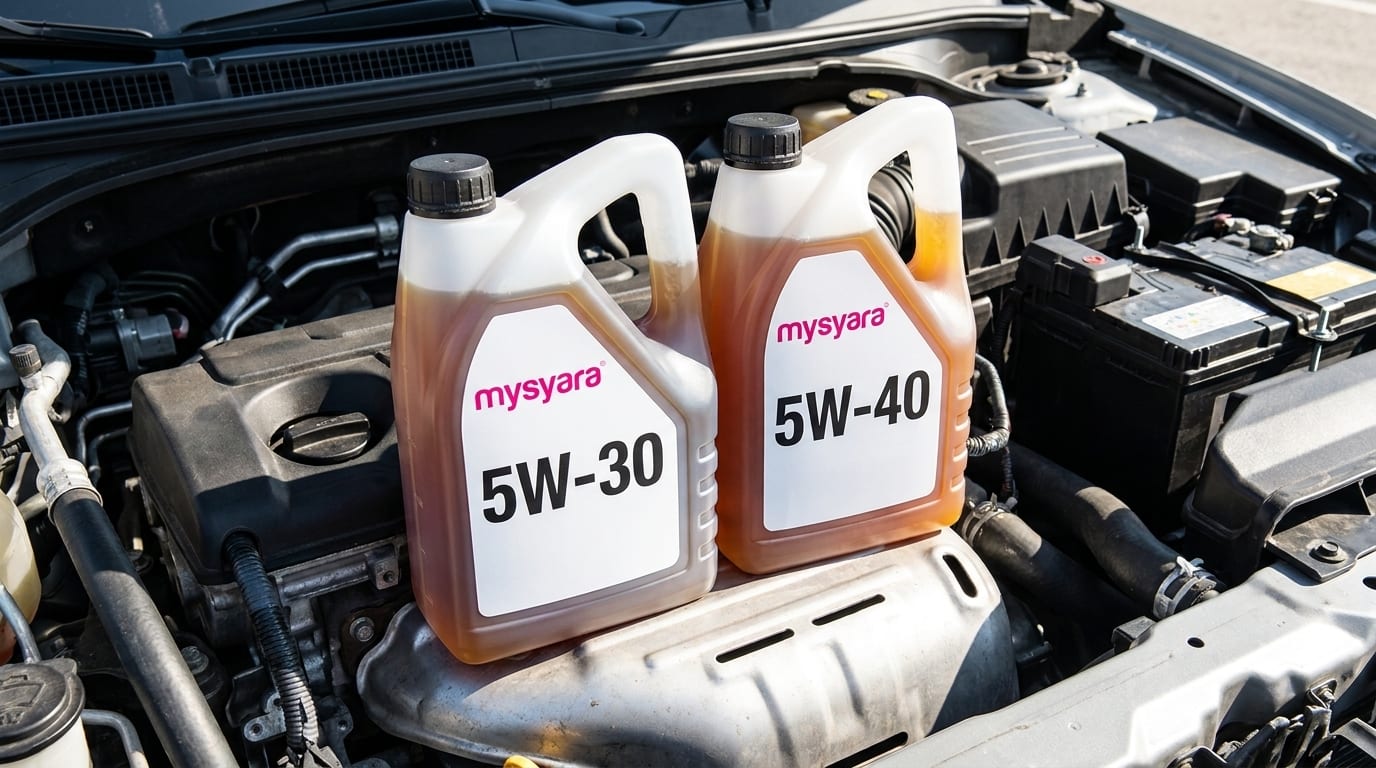
5W-30 vs 5W-40 Engine Oil: Which Does Your Car Need? (UAE)
Published 22 May 2026•9 min read
The right answer to "5W-30 vs 5W-40" is in your owner's manual, and that is genuinely the first thing to check, not a cop-out. But the manual doesn't explain what those numbers mean or why the second one matters more in a 45°C UAE summer. That's what this article covers.
Key Takeaways
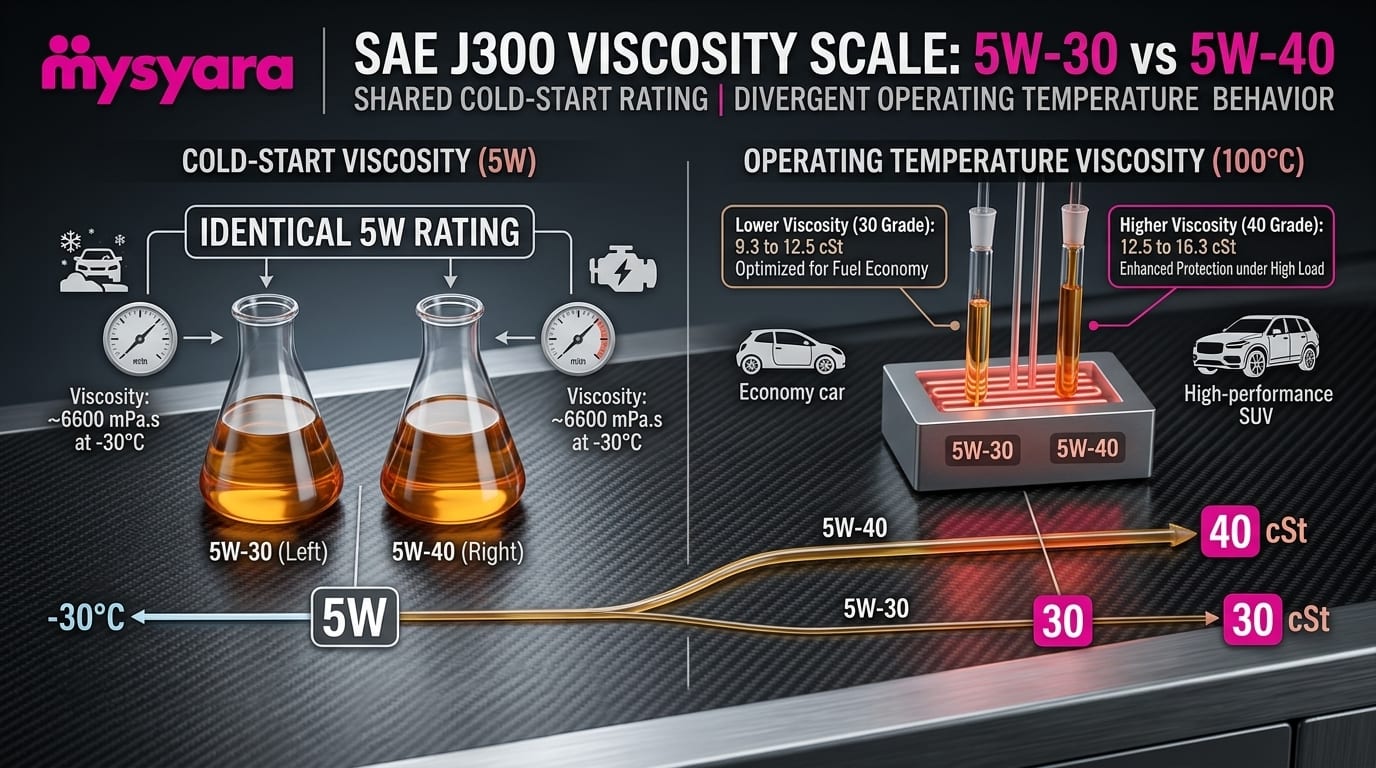
The "5W" part of both grades is identical: same cold-start performance. The only difference is hot operating thickness. 5W-40 is roughly 35% thicker at engine temperature.
Your owner's manual (or the sticker on the oil-filler cap) gives the correct grade for your car. Using the wrong grade (even a "heavier" one) can affect fuel economy and, in modern engines, engine response.
If the manual allows a range (e.g., "5W-30 or 5W-40"), the 40-weight option gives marginally better film protection in sustained high heat, particularly for UAE summers, high-mileage engines, or towing.
Most modern Japanese and Korean cars sold in the UAE specify 5W-30 (or even 0W-20). Many European performance cars and some diesel engines require 5W-40, often with an ACEA C3 certification.
The code on an engine oil bottle (5W-30, 5W-40, 10W-40) follows a standard set by SAE International called SAE J300. It measures two things: how the oil flows when cold, and how thick it stays when hot.
The number before "W" (the W stands for winter) describes the oil's cold-start behaviour. A lower number means better flow when the engine is cold. 5W-30 and 5W-40 share the same "5W" rating, so they perform identically at cold start. In UAE winters, temperatures rarely drop below 10-15°C, so the cold-start rating rarely matters here; it's reassuring to know neither grade will be sluggish on a chilly January morning in the mountains above Hatta.
The number after "W" is the hot operating viscosity, tested at 100°C. This is where 5W-30 and 5W-40 differ. According to SAE J300:
5W-30 has a kinematic viscosity of 9.3-12.5 cSt at 100°C
5W-40 has a kinematic viscosity of 12.5-16.3 cSt at 100°C
In plain English: 5W-40 is thicker when the engine is at operating temperature. A thicker oil film is harder to shear apart, which can mean better protection under high load and sustained heat.
Why the Second Number Matters More in the UAE
Engine oil has one job: keep a thin film of lubricant between moving metal parts so they don't touch. At higher temperatures, oil naturally thins out. If it thins too much, the film breaks down and metal contacts metal.
UAE summers regularly push ambient temperatures past 45°C. Engine bay temperatures are considerably higher for an engine running in stop-start traffic on the Dubai-Abu Dhabi highway at noon in August. This is the environment where the difference between a "30" and a "40" grade becomes real.
That said, the difference is not as dramatic as it sounds. Modern full-synthetic oils of both grades are engineered to resist thermal breakdown. A quality 5W-30 from Mobil, Shell, or Motul that meets the correct API or ACEA specification for your engine will protect it adequately through a UAE summer, provided you follow the correct oil-change interval and your engine isn't already worn or running hot for another reason.
The honest take: 5W-40 gives you a marginally thicker oil film at operating temperature. For most UAE car owners using a quality synthetic, the practical difference between a 5W-30 and a 5W-40 is small. The grade your OEM specified is the one calibrated for your engine's clearances and oil pressure. That matters more than adding a grade of thickness.
5W-30 vs 5W-40: Side by Side
5W-30
5W-40
Cold-start performance
Identical (5W)
Identical (5W)
Kinematic viscosity at 100°C
9.3-12.5 cSt
12.5-16.3 cSt
HTHS viscosity at 150°C (min)
2.9 cP
3.5 cP
Film thickness at operating temp
Thinner
Thicker
Fuel economy impact
Marginally better
Marginally lower
Best for
Modern fuel-efficient engines; many Japanese/Korean cars
High-mileage engines; European performance/diesel; towing
Common API/ACEA specs
API SP; ACEA A3/B4; C2
API SP; ACEA A3/B4; C3
UAE summer suitability
Adequate in a quality synthetic
Adequate; marginally more robust under sustained heat
This step matters more than any general advice about heat or grades.
Step 1: Check the oil-filler cap. Lift the bonnet and look at the cap marked "oil" on top of the engine. Many manufacturers print the recommended grade directly on it: you might see "5W-30" or "5W-40" or "0W-20". If you see a grade there, that's your answer.
Step 2: Check the owner's manual. Go to the lubrication or maintenance section. You'll find a table that usually lists a primary grade and may allow alternatives for different ambient temperatures. The manual might also specify an API service category (SP, SN) or an ACEA specification (A3/B4, C3) that the oil must meet. These matter for modern engines with particulate filters, variable valve timing, and turbos.
Step 3: Read both the SAE grade and the API/ACEA code. These are two different things. "5W-40 API SP" and "5W-40 ACEA C3" both use the same viscosity grade but have different additive packages. A BMW that requires "5W-40 ACEA C3" will not be served well by "5W-40 API SN": the ACEA C3 specification includes limits on sulphur ash that matter for the car's particulate filter. If in doubt, match both: the viscosity grade and the performance standard.
Consider a 2016 Nissan Patrol V8 owner who runs hard on the Abu Dhabi-Al Ain highway most weekends. The manual calls for 5W-30, but the oil-change workshop started putting 5W-40 in without asking. Checking the manual and confirming 5W-30 is the OEM spec is the right move. Both grades are fine for the Patrol, but using what Nissan engineered for the engine, not what the workshop had in bulk, is the correct call.
Which Grade for Which Car (UAE Scenarios)
The following are illustrative scenarios to help you identify where you might sit. Always check your own manual.
High-mileage Japanese or Korean SUVs (Patrol, Prado, Fortuner, Santa Fe, older Hilux): Many GCC-spec versions of these vehicles shipped with 5W-30 as the standard grade, while allowing 5W-40 for high-mileage or severe use. If your engine has 150,000 km or more, or if you tow regularly, and the manual allows it, moving to 5W-40 can help maintain oil pressure. Check the manual for the "severe service" or "high mileage" note.
Modern fuel-efficient Japanese and Korean sedans (Corolla, Civic, Accord, Camry, Sonata, recent models): Manufacturers such as Toyota and Honda have moved to thinner grades: 0W-20 in many current models, 5W-30 in slightly older ones. These engines are designed with tighter tolerances that rely on thinner oil for correct oil pressure response. Using 5W-40 in an engine specified for 0W-20 is not a safety improvement; it can reduce fuel economy and slow oil circulation to variable valve timing components.
European petrol cars (BMW 3/5 Series, Mercedes C/E Class, Audi A4/A6, VW Golf/Passat): Most post-2010 models require an ACEA C2 or C3 specified oil, often 5W-30 or 5W-40. The "C" ACEA category is not interchangeable with the "A/B" category; it exists to protect diesel particulate filters and catalytic converters. For a BMW X5 (2020 petrol turbo), the owner's manual specifies the exact ACEA category and an OEM approval number (BMW Longlife-XX). Using a generic 5W-40 that lacks the correct ACEA or BMW approval is not the right call, regardless of how thick the oil is. Check the manual for the full spec string, not just the viscosity grade.
Performance and diesel vehicles (Land Cruiser 200 V8 diesel, Range Rover, Jeep Grand Cherokee): These typically specify 5W-40 to maintain viscosity under the combined load of large displacement, turbocharging, and heat. An FJ Cruiser (4.0 V6) runs 5W-30 per Toyota's specification, and there is no reason to deviate. Quality synthetic at the correct grade is enough.
Older high-mileage engines (pre-2005 petrol or diesel, 200,000+ km): Some older engines with more internal wear can benefit from a thicker oil to maintain oil pressure at worn bearing surfaces. A few workshops recommend 10W-40 or even 20W-50 in genuinely worn engines, but only when the OEM allows it or a mechanic has assessed the engine condition. Do not do this without professional advice.
The Verdict: 5W-30 vs 5W-40 for UAE Drivers
For most UAE car owners, the right approach is:
Open the manual or check the oil-filler cap.
Note the SAE grade (5W-30, 5W-40, etc.) and any API/ACEA specification.
Buy a quality full synthetic that meets both.
Change it at the interval the manual recommends for severe service. In the UAE, that typically means following the shorter interval, around 10,000 km for most synthetics, rather than pushing to 15,000 km.
If the manual offers a choice and you drive hard, tow, or have a higher-mileage engine, lean toward 5W-40. If your manual specifies only one grade, use that grade. Going heavier than specified is not a free upgrade.
UAE conditions do not automatically mean everyone needs 5W-40. The climate is harsh, but quality synthetic oils of both grades are engineered for it. The OEM specification was set by engineers who tested the engine. Trust it.
Brands at MySyara Shop: once you know your grade and the API/ACEA certification, these are available across both 5W-30 and 5W-40:
Mobil: Mobil 1 and Mobil Super; wide API/ACEA coverage
Shell: Helix Ultra and Helix HX8; popular in UAE workshops
Motul: 8100 X-Cess (5W-40) and X-Clean+ (5W-30); well-regarded for European engines
Caltex: Havoline range; strong regional presence
Mannol: competitive pricing; meets most API/ACEA specs
Red Line: premium synthetic; popular with enthusiasts
Castrol is also widely stocked. Pick the brand within the grade and certification your manual calls for. A mid-range oil that meets the correct spec will protect your engine as well as the premium alternative.
Ready to order?Browse engine oil and lubricants at MySyara Shop: 5W-30, 5W-40, and other grades from Mobil, Shell, Motul, Caltex and more. Need the oil changed and don't want to do it yourself? MySyara Shop fits parts from AED 25; call +971 4 549 0333 to arrange fitment.
Frequently Asked Questions
Can I switch from 5W-30 to 5W-40 without checking the manual?
Only if your manual explicitly allows both grades. Some manuals list both as acceptable; others specify one grade only. Using 5W-40 in an engine designed for 5W-30 can be fine in some cars and problematic in others, particularly modern engines with tight tolerances or variable valve timing. Check first.
Does UAE heat mean I should always use 5W-40?
Not necessarily. Both grades are engineered to protect engines in hot climates when used in a quality full synthetic formulation. The OEM specification was set for your engine's specific clearances and oil pump pressure. The grade in your manual is the right starting point.
How often should I change engine oil in the UAE?
Full synthetic in normal UAE use: most workshops recommend 10,000 km as a practical interval, even if the oil is rated for 15,000 km. The combination of heat, stop-start urban driving, and dusty conditions shortens oil life relative to European highway driving. Conventional and synthetic-blend oils should be changed more frequently: every 5,000-7,000 km.
What does "API SP" on the label mean?API SP is the current performance standard for petrol engine oils set by the American Petroleum Institute, introduced in 2020. It supersedes older ratings (SN, SM, SL) and adds protections against low-speed pre-ignition (LSPI), timing chain wear, and high-temperature deposits. API SP is backward-compatible; it is safe to use in any engine that called for SN or older.
What if my oil-filler cap shows a different grade to my manual?
Follow the manual. The cap sometimes shows only the primary grade; the manual may allow alternatives for different ambient temperatures or service conditions. If in doubt, call our team on +971 4 549 0333 and describe your car; we can help you confirm the right spec before ordering.
Free UAE delivery on orders over AED 200UAE fitment available from AED 25Genuine parts backed by warrantyShips worldwide from Sharjah