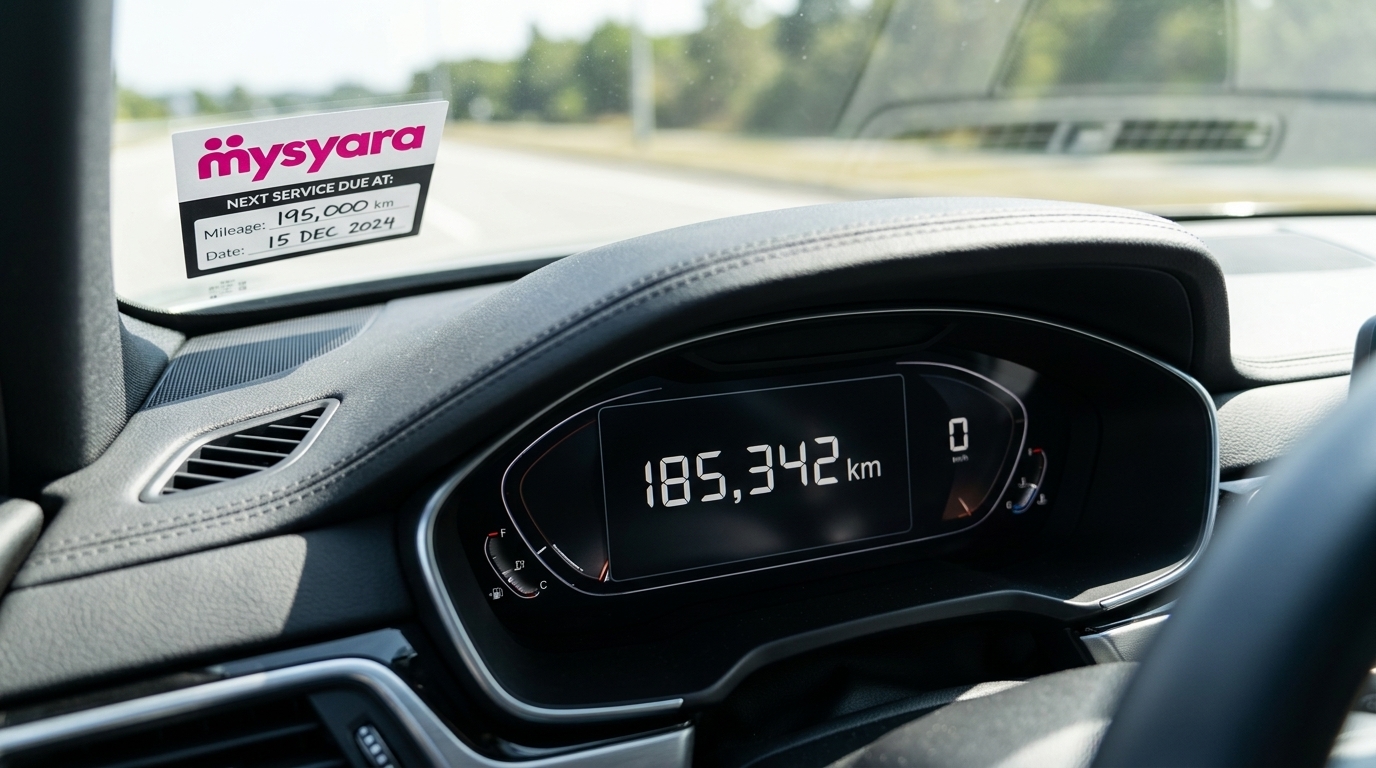
In the UAE, the practical engine oil change interval is 5,000 km for conventional/mineral oil, 7,500 km for synthetic-blend oil, and 10,000 km for full-synthetic oil. Those figures assume normal UAE driving: city stop-start plus highway runs in summer heat. Your owner's manual may quote a longer interval, and the bottle may say "up to 15,000 km" on full synthetic. In the UAE, those optimistic numbers apply to cool, stable climates with long highway drives. The combination of 45°C ambient heat, dusty roads, and short city trips is classified as "severe service" by every major car manufacturer, and severe service means shorter intervals.
Key Takeaways
Mineral/conventional oil: change every 5,000 km or 3 months in the UAE, whichever comes first.
Synthetic-blend (semi-synthetic): every 7,500 km or 6 months.
Full-synthetic: every 10,000 km or 6 months. The 15,000 km figure on the bottle applies to cool-climate highway driving, not UAE conditions.
UAE heat, fine sand, and frequent short trips all eat into oil life faster than the label assumes. Follow the shorter "severe service" schedule in your manual.
Changing oil is a reasonable DIY job for a confident owner; alternatively, MySyara Shop fits it from AED 25 (plus oil and filter cost).
Three things set the interval: oil type, how you drive, and engine age. Get these right and you won't over-spend on unnecessary changes or under-protect a hot engine.
Oil type: the biggest single lever
Oil type
Typical UAE interval
Notes
Conventional/mineral
5,000 km / 3 months
Older or high-mileage engines; budget change frequency
Synthetic-blend (semi-synthetic)
7,500 km / 6 months
Middle ground; good for mixed city/highway use
Full-synthetic
10,000 km / 6 months
Most modern cars; best heat stability; not immune to UAE conditions
Full-synthetic (extended-life label)
10,000–12,000 km max in UAE
The 15,000 km label applies in temperate climates only
The chemistry is straightforward. Mineral oil is refined from crude and starts to oxidise and thin out above about 100°C. Full synthetic is engineered to resist oxidation at 110–130°C, which is where UAE engine oil bulk temperatures can sit on a summer afternoon in traffic. Better thermal stability means longer useful life, but not infinite life.
Driving conditions: UAE is "severe service"
Every major car manufacturer publishes two service schedules: normal and severe. The severe-service schedule applies when most of the following are true:
Short trips under 10 km where the engine rarely reaches full operating temperature
Stop-start city driving for extended periods
Sustained high ambient temperatures (above 40°C)
Dusty or sandy conditions
For most UAE drivers, that list is an accurate description of a typical weekday. Short trips to the office in Deira, long idling in the Sheikh Zayed Road tailback at noon in August, sand blowing in from the desert road to Al Ain. Toyota, Nissan, and Honda GCC-spec manuals all acknowledge this explicitly in their footnotes. For UAE-based owners, the severe-service schedule is the one to follow.
Consider a 2016 Nissan Patrol driven mainly around Dubai during the week with the AC running hard, plus occasional longer runs to Abu Dhabi on weekends. The manual's normal schedule says 10,000 km. The GCC severe-service schedule says 5,000 km. For a car doing mostly city runs in UAE summer, the severe-service interval is the honest answer.
Engine age and condition
Older engines with more wear generate more combustion blow-by (gases leaking past worn piston rings into the oil), which contaminates the oil faster. For engines above about 150,000 km, shortening the interval by one step is sensible: a car that would normally use full-synthetic at 10,000 km intervals might benefit from 7,500 km once high mileage brings more blow-by. An engine that is already burning oil (losing more than 1 litre per 5,000 km) needs investigation, not just more frequent changes.
Why UAE Conditions Shorten the Engine Oil Change Interval
The UAE is genuinely hard on engine oil. Understanding why helps you take the interval seriously rather than treating it as a workshop upsell.
Heat accelerates oxidation
Engine oil oxidises as it works. Every 10°C rise above 80°C roughly doubles the rate at which oil breaks down, a well-established principle in lubrication science known as the Arrhenius relationship (motor oil degradation chemistry via Wikipedia). UAE ambient temperatures hit 45–47°C in summer. Engine bay temperatures during city driving can reach 80–100°C. The oil itself, depending on the engine and driving conditions, can run at 110–130°C in sustained heat. That is 30–50°C above the benchmark conditions a temperate-climate interval is calibrated for. The additive package that keeps oil slippery, clean, and corrosion-resistant depletes correspondingly faster.
Fine sand contamination
UAE air carries fine sand particles, especially on desert routes, in Sharjah's industrial districts, or anywhere outside central Dubai. Particles smaller than 10 microns can pass through an air filter if the filter is due for replacement, is damaged, or if the car is driven off-road without a quality pre-cleaner. Once in the oil, abrasive particles accelerate wear on bearing surfaces and speed up oil darkening. A fresh oil sample is amber; after 5,000 km of UAE city driving it may already be noticeably darker than it would be after the same distance in a cooler, cleaner environment.
Short trips and fuel dilution
An engine that does not reach full operating temperature (typically 80–90°C) on most journeys allows small amounts of fuel and moisture to condense in the oil. This fuel dilution thins the oil and depletes the corrosion inhibitors. In a city driving pattern common in Dubai, where many journeys are under 15 km, the engine may never fully warm. Over time, fuel-diluted oil loses its protective viscosity faster than the interval on the bottle assumes.
The 15,000 km label is not wrong, just written for a different world
A quality full-synthetic oil rated for 15,000 km is engineered to do exactly that job, in European motorway conditions where engines run at a stable temperature for long stretches, dust is minimal, and ambient temperatures rarely go above 30°C. That is not the UAE. The same oil used in UAE city driving will be more degraded at 10,000 km than it would be at 15,000 km in Germany. This is not marketing scepticism; it is the logic behind every OEM's severe-service schedule.
OEM Recommendations vs Real-World UAE Intervals
Here is where the major manufacturers sit on UAE intervals, based on their GCC-specification severe-service schedules:
Manufacturer
Severe-service interval (full synthetic)
Notes
Toyota GCC
5,000 km / 3 months
Many models; some newer engines move to 10,000 km
Nissan GCC
5,000–10,000 km / 6 months
Varies by model; Patrol V8 workshops advise 10,000 km
Honda GCC
5,000 km (conventional/blend); 10,000 km (full synthetic)
Civic, Accord; Honda MINDER system-based on some models
BMW, Mercedes, Audi
10,000–15,000 km (not 20,000–30,000 km Longlife)
European Longlife intervals are not designed for UAE heat and city driving; cut in half
Hyundai/Kia GCC
10,000 km (full synthetic)
The practical consensus among UAE workshops: 10,000 km on full-synthetic is the widely used interval for modern cars; 5,000–7,500 km for older engines or mineral/blend oil. Most reputable workshops will not push you to the 15,000 km mark, because they see the oil when it comes out.
A 2020 BMW X5 in Abu Dhabi is a good example: the dashboard service indicator follows BMW's Longlife schedule, which can stretch to 25,000–30,000 km. In Germany that interval is supported by the extended drain oil the factory fills and long motorway trips. In Abu Dhabi, running the AC flat out in traffic for most journeys, following that interval to the letter is a risk most UAE BMW workshops would not recommend. A 10,000–15,000 km interval on the correct Longlife-01 approved full-synthetic is a much safer UAE position.
Signs You Have Waited Too Long
The interval is a guide, not a guarantee. Check the oil on the dipstick every month regardless of the interval.
Oil colour: fresh oil is amber/golden. Dark brown is normal as it works. Black and gritty means the oil is well past its protective life.
Oil level dropping: losing more than 1 litre per 5,000 km suggests burning oil, not just a long interval. Investigate.
Burning or acrid smell: hot, degraded oil from the engine bay area.
Tapping or ticking on cold start: oil not reaching components fast enough; could indicate sludge or low pressure from degraded oil.
Oil pressure warning light: act immediately. Do not continue driving; check the level and seek a workshop.
Thick, dark residue on the dipstick: sludge forming from long-degraded oil. This is the outcome of too many too-long intervals and can cause lasting engine damage.
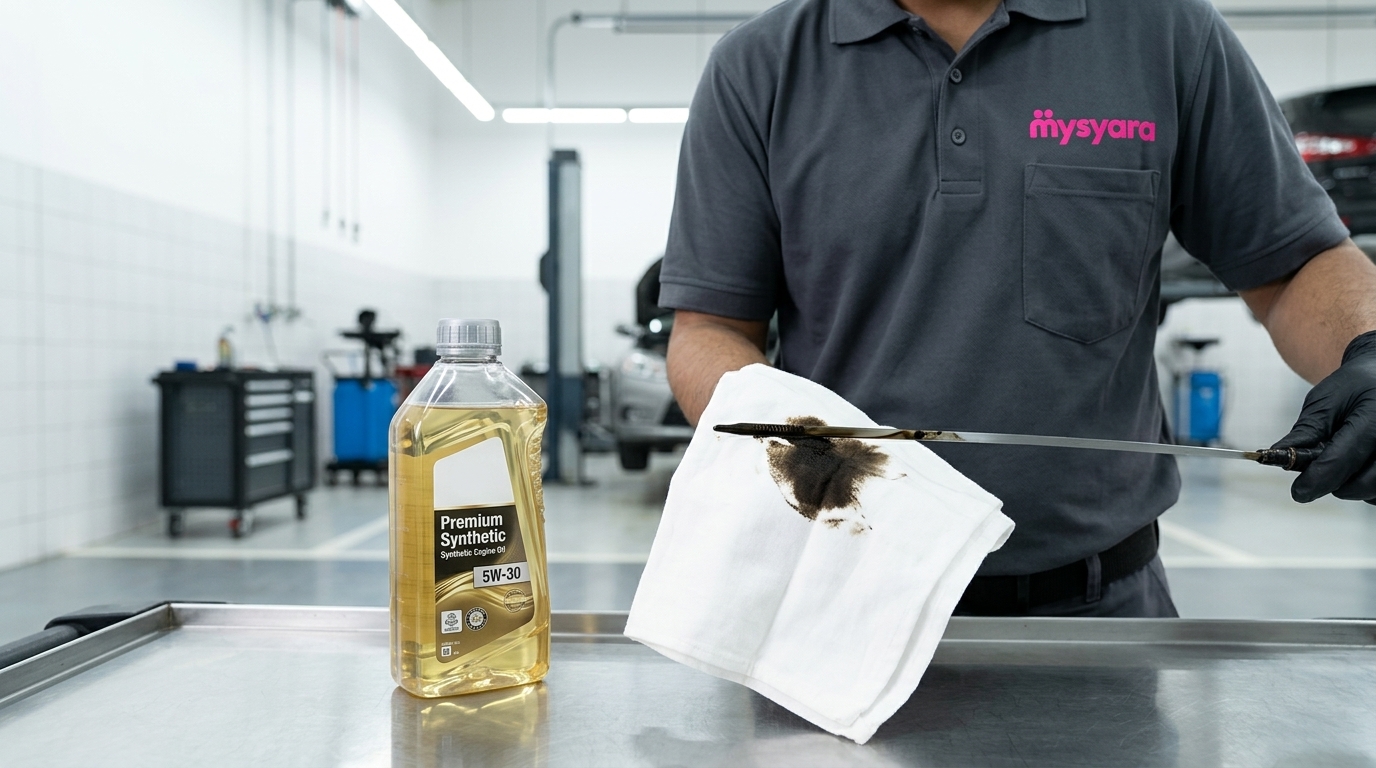
One quick check that takes two minutes: pull the dipstick, wipe it on a white cloth, and look at the colour. If it is black and opaque, change it regardless of where you are in the interval.
Interval by Oil Type: Quick-Reference Table
Oil type
Normal UAE change interval
Severe-service UAE interval
When it applies
Mineral/conventional
5,000 km / 3 months
3,000–5,000 km / 3 months
Older cars, pre-2005 engines, budget servicing
Synthetic-blend
7,500 km / 6 months
5,000 km / 3–4 months
Mixed-use driving, 2005–2015 era cars
Full-synthetic
10,000 km / 6 months
7,500 km / 4–6 months
Most modern cars; the standard UAE recommendation
Full-synthetic (extended-life)
10,000–12,000 km
10,000 km
Extended life labels are for temperate climates; cap at 10,000 km in UAE
For most UAE car owners in a modern petrol car, full-synthetic at 10,000 km is the right headline interval. If you do mostly short city trips, lean toward 7,500 km.
DIY Oil Change or Get It Fitted?
An oil change is one of the more accessible DIY jobs for a mechanically confident owner.
What you need:
The correct grade and quantity of oil (check the owner's manual for both)
A new oil filter that matches your engine
An oil filter wrench, drain pan, and a car jack with axle stands
Gloves and a tray for mess
Time: 30–45 minutes for a confident first-timer; 20 minutes once you have done it a few times.
Common mistakes: over-tightening the drain plug and stripping the threads, fitting the wrong oil filter, or not checking the level after refilling. These are fixable but avoidable.
The fitment path: if you would rather not do it yourself, MySyara Shop fits oil changes from AED 25, plus the cost of the oil and filter. You can call +971 4 549 0333 to arrange it at the workshop or discuss scheduling.
Used oil disposal
Used engine oil is hazardous waste. Do not pour it down a drain, into soil, or into general rubbish. ENOC and ADNOC petrol stations across the UAE accept used oil for recycling. Some workshops will take it back too. Responsible disposal is a small but real part of any oil change.
How to Choose the Right Oil
The interval question and the oil-grade question are linked. Once you know the interval, you also need the right grade. The 5W-30 vs 5W-40 comparison article covers the viscosity decision in full; the short version is that the grade on your oil-filler cap or in your owner's manual is the correct starting point.
For the brands available in UAE: Mobil 1 and Shell Helix Ultra cover most common grades (5W-30, 5W-40, 0W-20) with API SP and relevant ACEA certifications. Motul, Caltex, Mannol and other brands at MySyara Shop cover specific grades and price points. The quality of oil matters more than the brand within the right grade and certification; a mid-range oil that meets the correct API SP specification protects as well as a premium one in normal use.
FAQ
How often should I change engine oil in Dubai?
For a modern car on full-synthetic oil, 10,000 km or every 6 months, whichever comes first, is the practical UAE interval. For an older car or mineral/conventional oil, 5,000 km or every 3 months. The heat and dust in Dubai classify most driving as "severe service," which means following the shorter schedule in your owner's manual.
Does the 15,000 km oil-change interval on the bottle apply in the UAE?
Not reliably. Extended-life intervals on full-synthetic bottles are calibrated for stable, cool climates with long motorway driving. UAE city heat, stop-start driving, and occasional dusty roads shorten the effective life of the oil. Most UAE workshops and OEM severe-service schedules put the practical ceiling at 10,000 km for full-synthetic in this climate.
Can I change engine oil less often if my car has an oil life monitor?
Oil life monitors (like Honda's MINDER or GM's Oil Life System) estimate degradation based on engine revs, temperature, and time. They are a useful guide but are calibrated on average driving assumptions, often in cooler-climate baseline testing. In UAE conditions, treat the monitor's reading as an upper limit rather than an exact trigger. If it shows 20–30% life remaining and you are approaching 10,000 km, change it.
Is it bad to change engine oil too early?
It is not harmful to the engine, but it wastes money and oil. Changing at 5,000 km when a full-synthetic at 10,000 km would have been perfectly fine is an unnecessary cost. Follow the interval appropriate to your oil type and conditions.
What is "severe service" and does it apply to my UAE driving?
Severe service is defined by car manufacturers as driving conditions that put extra stress on the oil: short trips, sustained high heat, dusty or sandy environments, heavy towing or load. For most UAE drivers doing daily city trips in summer, the answer is yes. Check your owner's manual for the severe-service interval; it is usually 40–50% shorter than the normal interval.
What engine oil brands does MySyara Shop stock?
The shop carries Mobil, Shell, Motul, Caltex, Mannol, Red Line, Formula 1 and others, across grades from 0W-20 to 20W-50. See the full range in the oil and lubricants section at the end of this article.
Ready to sort the oil change?Browse engine oil and lubricants at MySyara Shop: 5W-30, 5W-40, 0W-20 and other grades from Mobil, Shell, Motul and more. Don't want to do it yourself? MySyara Shop fits oil changes from AED 25 (plus oil and filter cost). Call +971 4 549 0333 to arrange fitment at the workshop or discuss your options.
Free UAE delivery on orders over AED 200UAE fitment available from AED 25Genuine parts backed by warrantyShips worldwide from Sharjah