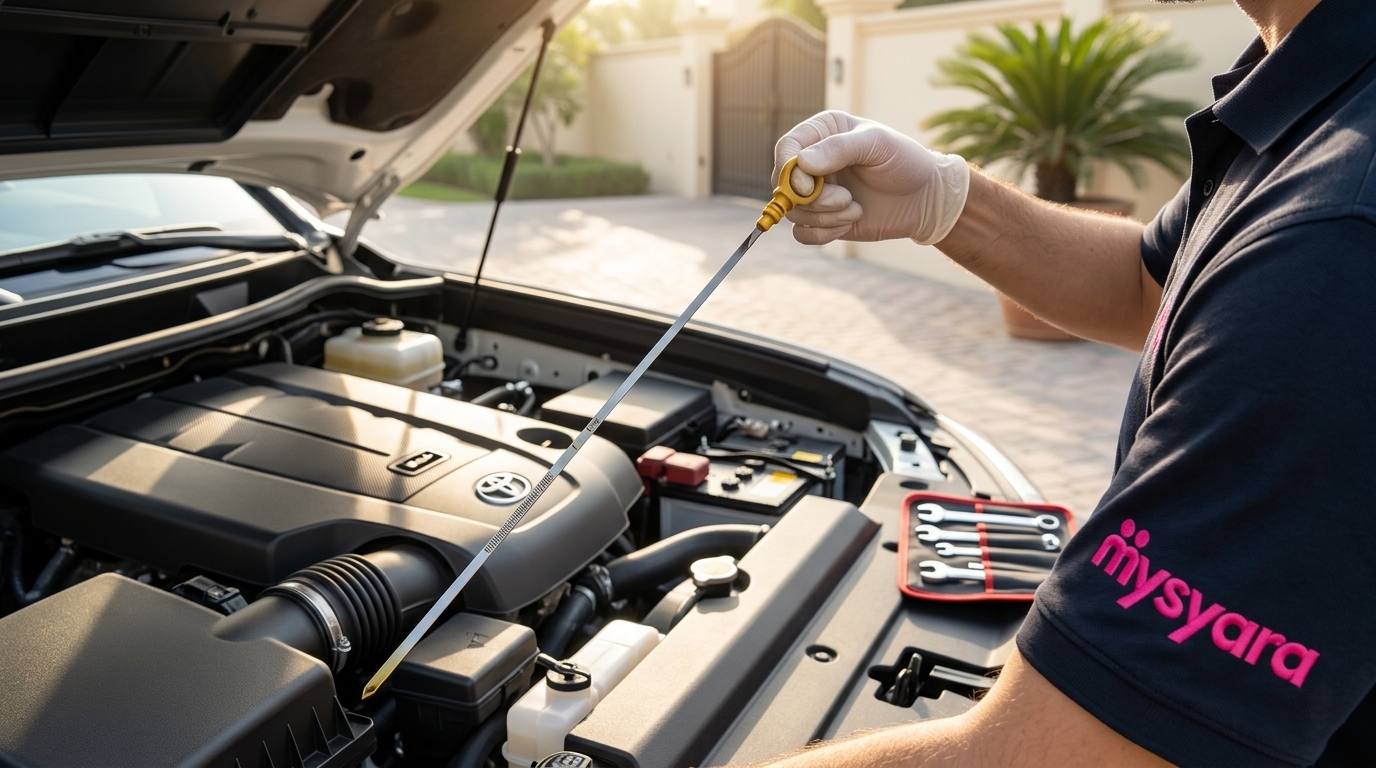
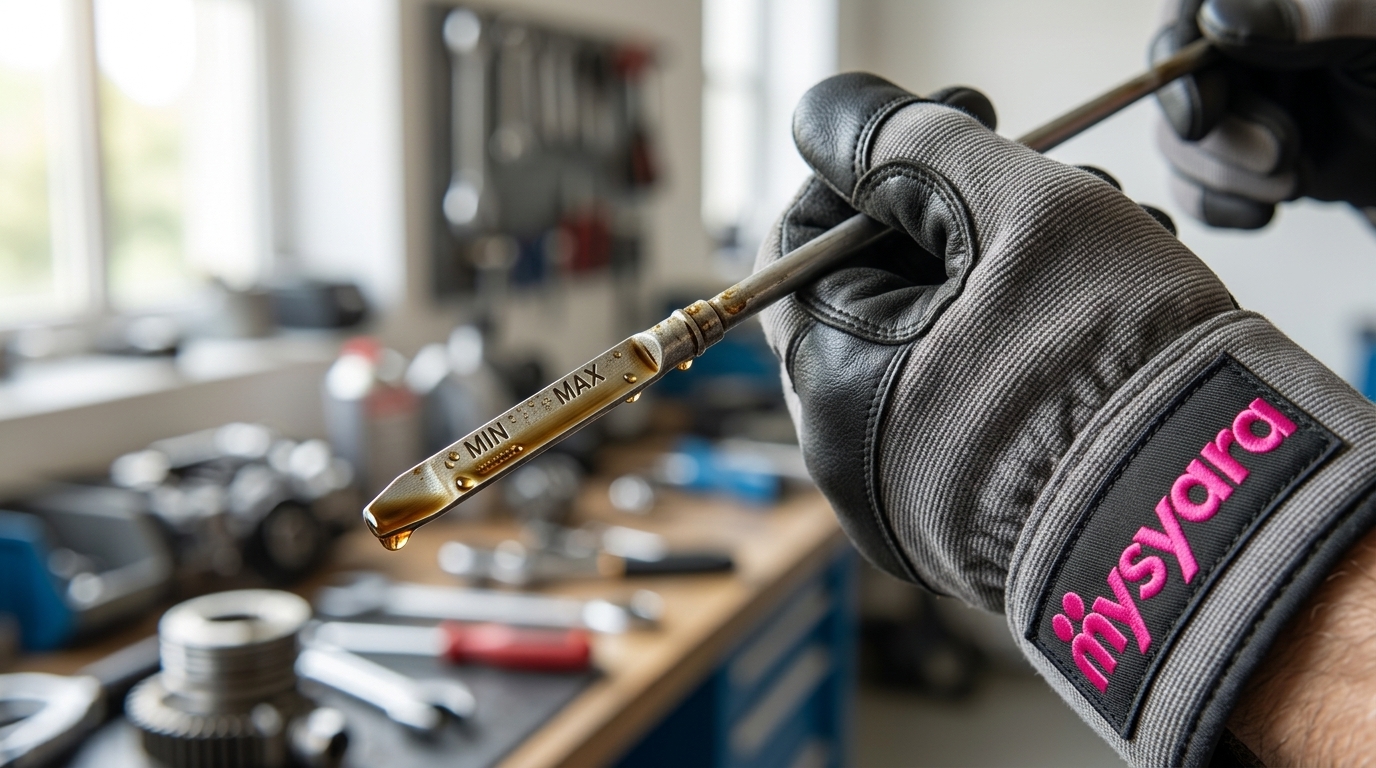
To check your engine oil level: park on level ground, turn the engine off and wait at least 10 minutes for the oil to drain back to the sump, pull out the dipstick and wipe it clean with a dry cloth, push it all the way back in, pull it out again, and read where the oil sits between the MIN and MAX marks. It should be somewhere in the upper half of that range. If it is at or below the MIN mark, top up. If it is above MAX, that is a problem worth addressing promptly.
That is the complete answer. The rest of this article explains why each step matters, what the reading looks like in UAE summer heat, and what to do when the level is wrong in either direction.
Key Takeaways
Always check oil on a level surface with the engine off after at least 10 minutes. A sloped driveway or a hot running engine both give misleading readings.
Wipe and re-dip: one dip gives you a dirty, smeared result. Two dips give you the real level.
Oil expands when hot. In UAE summer conditions, a reading taken immediately after switching off can show slightly higher than the true settled level; waiting 10–15 minutes is more reliable.
An oil level below MIN needs a top-up before your next drive. A level above MAX needs oil removed; overfilling is genuinely harmful to seals and the catalytic converter.
Check the oil every two to four weeks in normal UAE driving, and always before a long trip or before the UAE summer ramp-up.
When to Check Your Engine Oil Level
The old rule of thumb was once a week. For most modern engines in good condition, once every two to four weeks is a realistic and adequate schedule. The more important moments are:
Before a long drive (Abu Dhabi to Al Ain, or heading up towards Fujairah through the Hajar Mountains)
Before UAE summer starts (around April, before temperatures consistently push past 40°C)
If the oil warning light appears, this means the oil pressure has dropped to a critical level; pull over safely and check immediately
After a recent oil change, to confirm the level was filled correctly
If you notice the oil is darker than usual on a quick dip, because UAE driving (short trips, heat, sand) accelerates oil breakdown
A common habit among Dubai drivers: check the oil on the first Sunday of each month while the car cools down from the morning school run. It takes two minutes, costs nothing, and catches slow oil leaks before they become expensive repairs, exactly the kind of early warning a Patrol owner in Dubai found when doing this routinely with AC running hard from April through October.
Most modern cars also show a low-oil warning light before the level reaches a damaging point. But the warning light is a safety net, not a substitute for regular checks. In UAE heat, oil can drop from normal to dangerously low between checks if there is a slow leak or unusually high consumption.
What You Need
Nothing special:
A clean, dry cloth or a few sheets of kitchen paper
Level ground (a flat car park or garage floor)
10–15 minutes since the engine was last running
That is it. No tools, no expense. The bonnet release is usually a lever inside the car by the driver's footwell, then a safety catch at the front of the bonnet.
Step-by-Step: How to Check Engine Oil Level
Step 1: Park on level ground and switch off the engine
A slope skews the reading in either direction depending on which way the car is facing. A flat car park or garage floor is ideal. Once the engine is off, wait at least 10 minutes. During this time, oil that is sitting in the upper parts of the engine (around the valve cover, oil galleries, and cylinder head) drains back down to the sump at the bottom of the engine, where the dipstick measures.
In UAE summer, engine bay temperatures after a drive can be very high. Waiting 10–15 minutes is also a basic safety step; touching a very hot engine component is a real risk when the bonnet is open. The oil itself, when the engine is at full operating temperature, can be around 100–130°C. Fifteen minutes of cooling makes the job safer.
Step 2: Open the bonnet and find the dipstick
The dipstick is a long, thin metal rod with a brightly coloured handle, usually yellow or orange, sitting in a tube that goes into the engine block. In most cars it is clearly labelled with an oil-can symbol. In modern Japanese and Korean cars (Toyota Corolla, Nissan Sunny, Hyundai Tucson), the dipstick is near the front or side of the engine and straightforward to reach. In some European cars, the dipstick tube is more tucked away; the owner's manual will show its location if you are unsure.
A small number of newer vehicles (some BMW, Mercedes, and Volkswagen models) have replaced the physical dipstick with an electronic oil-level sensor and report the level through the dashboard display instead. If there is no dipstick to find, check the instrument cluster menu for oil level; your owner's manual will confirm which system your car uses.
Step 3: Pull out the dipstick and wipe it clean
Pull the dipstick straight out of its tube and wipe the entire bottom section with your clean cloth or paper. This removes any oil that splashed onto the stick during driving and gives you a blank reading surface. Do not try to read the level at this point; the first pull is always contaminated.
Step 4: Re-insert the dipstick fully and pull it out again
Push the dipstick all the way back into the tube until it seats properly, then pull it straight out again. This second pull is your real reading. Hold the dipstick horizontally and look at where the oil film ends relative to the MIN and MAX marks.
Step 5: Read the level between MIN and MAX
The two marks on the bottom of the dipstick define the safe operating range:
Reading
What it means
What to do
Above MAX
Oil overfilled
Do not top up further; see the overfilling section below
Between halfway and MAX
Ideal range
Nothing; check again in 2–4 weeks
Between MIN and halfway
Low but safe for now
Top up at your next opportunity; do not delay more than a few days
At or below MIN
Dangerously low
Top up before driving again
No oil visible on the dipstick
Critical
Top up immediately; investigate the cause
The distance between MIN and MAX on most engines represents roughly one litre of oil. Aim to keep the level in the upper half of the range, not scraping the bottom.
Reading the Level in UAE Summer Heat
Here is the caveat that catches new UAE drivers. Engine oil expands when it is hot, so a reading taken shortly after a hot drive will show the level sitting slightly higher than when the oil is fully settled and cold. The thermal expansion of engine oil at operating temperature versus ambient temperature is around 7–8% of total volume. For a 5-litre sump, that is roughly 350–400 ml of apparent difference.
In practice, this means:
If you check the oil immediately after a long summer drive and it reads just above the halfway mark, it may actually be a touch lower once cold.
If it reads right at MAX immediately after a hot drive, wait 15 minutes and re-check; it may settle to a correct level.
If you check in a shaded garage, the engine cools faster than in an outdoor car park in the August sun. Both are fine; just give it the full 10–15 minutes.
The safest habit is to check in the morning before the first drive, when the oil has had the whole night to settle and cool. This gives the most consistent reading over time and removes the hot-oil ambiguity entirely.
A note on reading location: a dipstick held at an angle reads differently from one held horizontally. Once you pull it out, hold it level (parallel to the ground) before reading. If you hold it pointing downward, the oil runs toward the tip and appears higher than it is.
What to Do if the Level Is Low
If the oil is at or below the MIN mark, the engine needs a top-up before you drive any distance. Here is how to do it without making things worse.
Find the right grade first. Check the oil-filler cap on top of the engine (it usually shows the grade, for example "5W-30" or "5W-40") or look in the owner's manual. Adding the wrong grade of oil is not ideal; adding the correct grade is a five-minute job. If you are genuinely uncertain, browse engine oil at MySyara Shop by your car make and model, or call the sales line to ask.
Add a little at a time. Remove the oil-filler cap (twist it off; it is usually marked with an oil-can symbol), pour in roughly 200–300 ml, wait two minutes for it to settle, then re-check with the dipstick. Repeat until the level is in the upper half of the range. The space between MIN and MAX is about one litre; if you are at MIN you need around 500–800 ml to reach a safe level. Do not pour in a full litre at once.
What oil to add? If the car is already running a fully synthetic oil, add the same grade of fully synthetic. If it is running a semi-synthetic, add the same. Adding a different type in a small top-up quantity is unlikely to cause harm, but matching the existing oil is the better habit. For the type question (synthetic vs mineral) and grade question (5W-30 vs 5W-40), see the related guides at the end of this article.
How much is normal consumption? For a healthy naturally aspirated petrol engine, losing around 0.5–1 litre every 5,000 km is within the range some manufacturers consider acceptable. Turbocharged engines may legitimately use a little more. If you are topping up more than 1 litre per 1,000 km, the engine is burning or leaking oil and needs a proper inspection; frequent top-ups are not a substitute for diagnosing the cause.
A 2020 BMW X5 owner noticed the oil level sat just above MIN during a routine check. She added half a litre of the correct fully synthetic 5W-30 (the manual specifies Longlife-01), confirmed the level had moved back into range, and made a note to monitor it over the next two weeks. The level did not drop further, so it was a minor top-up after a longer-than-usual interval, not a sign of a leak.
What to Do if the Level Is Overfilled
Overfilling the engine with oil is a genuine problem, not just an inconvenience. Here is why, and what to do.
When there is too much oil in the sump, the rotating crankshaft sits closer to (or actually touches) the oil surface and beats it into foam. Foamy, aerated oil cannot form the protective film that stops metal touching metal. The lubrication breaks down even though there is plenty of oil in the engine.
Beyond that, excess oil raises pressure inside the crankcase and forces oil past seals and gaskets. Front and rear main seals, which are expensive to replace, are common casualties. Oil vapour pushed through the PCV (Positive Crankcase Ventilation) system into the intake can also reach the combustion chamber and create ash deposits in the catalytic converter, reducing its efficiency over time.
The practical risk levels are roughly:
5–10 mm above MAX on the dipstick: borderline; worth monitoring but not urgent if a single check
More than 10 mm above MAX, or clearly above the crosshatched zone: drain off the excess or book a service to have it drained
Do not try to simply drive it off; the engine uses oil for combustion at a negligible rate and the excess will not correct itself. To remove oil yourself, you need to drain from the drain plug or use an oil extractor pump through the dipstick tube. If neither option suits you, a workshop can sort it in minutes.
One common cause of overfilling: doing a DIY oil change, pouring in the specified volume per the manual, then finding the dipstick reads over MAX. This happens when not all the old oil drained out, or when the filter was changed and the fresh filter added to the total volume. In that case, a small drain-off to bring it back within range is the fix.
What Dark or Dirty Oil on the Dipstick Is Telling You
Reading the oil level is one thing; reading the oil condition is another, and the dipstick gives you both at the same time.
Fresh oil is amber to golden brown and translucent. When you wipe it on a white cloth, the mark is light brown with a clear edge.
Oil that has been working for a while goes darker brown to black. This is normal; oil contains detergent additives that trap combustion by-products (soot and carbon), keeping the engine clean by holding those particles in suspension until the oil is drained. Darker oil is not automatically bad oil.
Oil that needs changing is black, opaque, and gritty when rubbed between two fingers. If the dipstick leaves a thick, opaque, almost tarry mark on the cloth, the oil is past its useful life regardless of the km reading on your service sticker.
Signs that go beyond a normal oil change:
A milky or creamy appearance (water in the oil, often a head gasket symptom)
A strong petrol smell in the oil (fuel dilution from repeated short trips or a rich-running engine)
Metal particles visible in the oil on the cloth (internal wear that needs a workshop inspection)
If the oil is simply dark but not gritty, check your engine oil change interval for UAE driving conditions to see whether an oil change is due. In UAE conditions, following the shorter severe-service interval (10,000 km on full synthetic for most modern cars) keeps the oil within its useful life.
Which Oil to Use for a Top-Up
The answer is always in your owner's manual or on the oil-filler cap: match the grade (such as 5W-30 or 5W-40) and the oil type (synthetic or mineral) specified for your engine.
For the grade decision in UAE conditions, the 5W-30 vs 5W-40 comparison covers the viscosity question in full. For the type question, the synthetic vs mineral engine oil guide walks through why UAE heat tilts most modern cars toward fully synthetic.
A few reliable options stocked at MySyara Shop that cover the most common UAE grades:
Mobil 1 (fully synthetic, 5W-30 and 5W-40, API SP, ACEA A3/B4), covers most Japanese and Korean cars, many European petrol engines
Shell Helix Ultra (fully synthetic, 5W-30 and 5W-40, API SP), widely used across the UAE for Toyota, Nissan, and Mitsubishi fleet
Caltex Havoline, Motul 8100, Mannol, Formula 1 and Red Line cover specific grades and budget ranges
These are named as stocked examples, not a verdict that they outperform other oils of the same grade and certification. The grade and API/ACEA specification your manual lists matter more than the brand, within the quality range of reputable oils.
When to Skip DIY and Book a Service
Checking the oil level yourself is a two-minute job that any driver can do. Adding oil to a car with a low level is simple. But there are situations where the right call is to book a service rather than top up and carry on:
The oil is below MIN and you have no suitable oil with you (do not drive; add oil first)
The oil is black and gritty and you are beyond your change interval
The dipstick shows a milky or creamy film (workshop inspection required; possible coolant leak into the oil)
The oil level keeps dropping and you are topping up more than 1 litre per 1,000 km
The oil-pressure warning light has come on (pull over safely; do not keep driving)
The oil is overfilled and you are not comfortable draining it yourself
For any of these situations, MySyara Shop fits oil changes and services from AED 25 (plus the cost of oil and filter). Call +971 4 549 0333 to book at the workshop or ask about scheduling a visit. Physical locations are in Al Quoz Industrial 3 (Dubai), Umm Ramool/Rashidiya (Dubai), Wadi Al Amardi (Dubai), and Rawda 1 (Ajman).
Frequently Asked Questions
How often should I check the engine oil level in the UAE?
Every two to four weeks for routine monitoring, always before a long drive, and before the UAE summer heat sets in (around April). If the oil warning light appears, check it immediately. Modern engines with low-oil warning sensors do give you some advance notice, but regular checks catch slow leaks before the light ever comes on.
Should I check the engine oil when hot or cold?
Cold is more consistent. The ideal is first thing in the morning, before the engine has been started, when the oil has had overnight to settle back into the sump and fully cool down. If the engine has been running, wait at least 10–15 minutes after switching off before reading the dipstick. In UAE summer, the engine retains heat longer, so 15 minutes is a safer target than 10.
The dipstick reads above MAX. Is that a problem?
Yes. Even a moderate overfill causes the crankshaft to beat oil into foam, which breaks down the protective film. The excess also raises crankcase pressure and can force oil past seals. If the reading is well above MAX, drain off the excess or have a workshop do it; do not drive with significantly overfilled oil expecting it to sort itself out.
Why does my oil level look different when the car has been parked overnight versus after a long drive?
Engine oil expands when hot. A reading taken 5 minutes after a summer highway run will show a slightly higher level than the same oil checked cold the next morning. The thermal expansion is roughly 7–8% of total volume for a typical 5-litre sump. Wait 10–15 minutes after driving before checking for a representative reading; overnight is best.
Can I mix different brands of engine oil when topping up?
Yes, within reason. Mixing oils of the same grade and type (for example, a fully synthetic 5W-30 from one brand with a fully synthetic 5W-30 from another) is safe for a top-up. The chemistry is compatible. What to avoid is mixing a fully synthetic with a mineral oil in the same sump, or adding a grade that does not match your manual's specification.
My oil is very dark. Does that mean I need to change it?
Dark colour alone is not enough to condemn an oil. Engine oil turns dark as the detergent additives trap combustion by-products; this is the oil doing its job. Black and opaque is a sign of a well-used oil that should be changed at or before the next scheduled interval. Gritty, thick, or tarry oil, or oil with a milky tint, are the signals to act on immediately. See the earlier section on reading oil condition, or check the engine oil change interval guide for the correct UAE schedule.
My car doesn't have a dipstick. How do I check the oil?
Some newer European cars (certain BMW, Mercedes-Benz, and Volkswagen models) have removed the physical dipstick and rely on an electronic oil-level sensor. Check the instrument cluster: there is usually an oil level display accessible through the car's on-board computer or infotainment menu. Refer to your owner's manual for the exact path to the oil-level display in your model.
Ready to top up or overdue for an oil change?Browse engine oil and lubricants at MySyara Shop: fully synthetic, semi-synthetic, and mineral grades from Mobil, Shell, Caltex, Motul, Mannol, Formula 1 and more, covering 5W-30, 5W-40, 0W-20 and other grades for most cars on UAE roads. Prefer not to deal with it yourself? MySyara Shop fits oil changes from AED 25 (plus oil and filter cost). Call +971 4 549 0333 to arrange fitment at a UAE workshop location convenient to you.
Free UAE delivery on orders over AED 200UAE fitment available from AED 25Genuine parts backed by warrantyShips worldwide from Sharjah