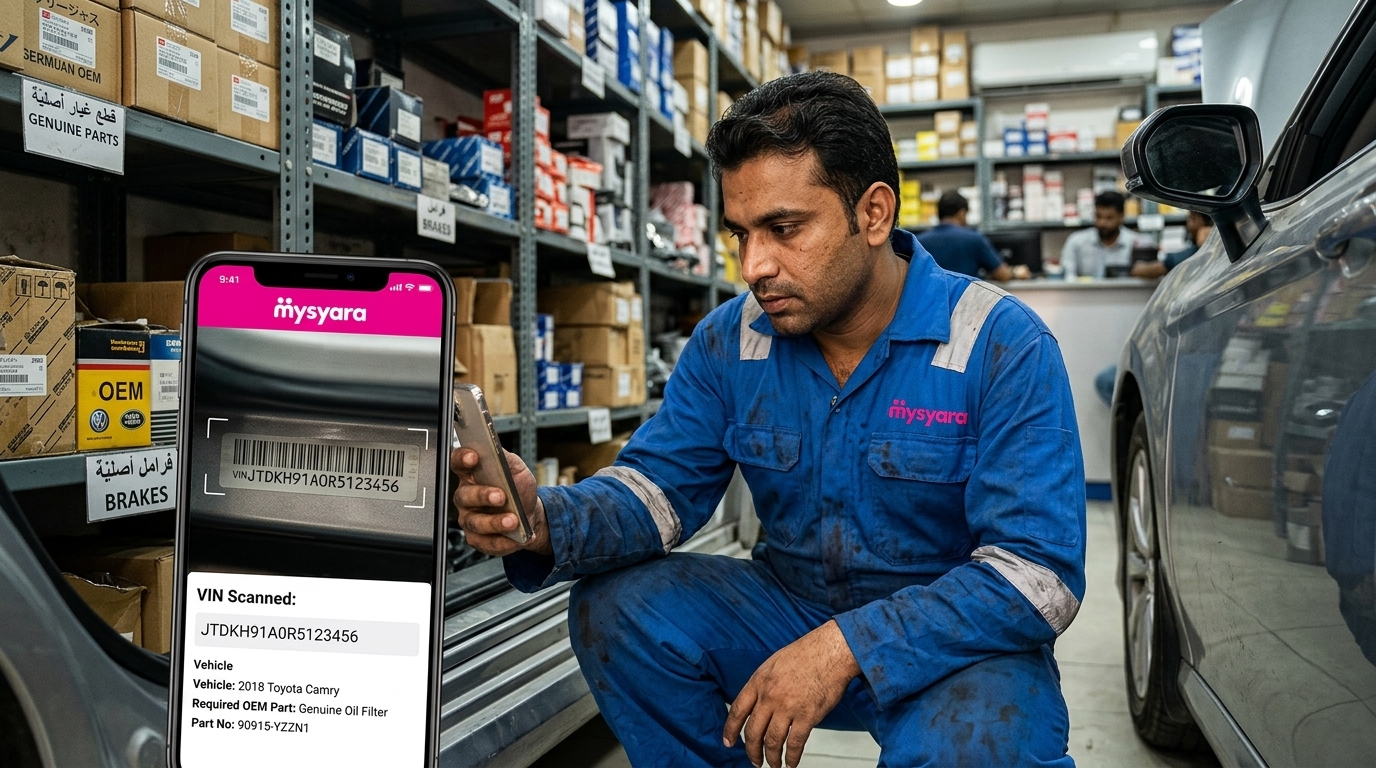
OEM Numbers and VIN: Finding the Right Car Part in UAE
Published 30 May 2026•13 min read
You have a part that needs replacing and a number on the old one. Or a neighbour told you to search "the OEM number" and now you're wondering what that actually means. Either way, the path from number to correct part involves a few things worth understanding before you hand over money, because a part that looks right can still be wrong for your exact car.
This guide covers what an OEM number is, where to find one, how to read your VIN to confirm your car's exact variant, and why "compatible with your model" in an online listing is not the same as "will definitely fit your car". It also shows the fastest honest path to getting the right part ordered and fitted, whether you know the number already or you are starting from nothing.
Key Takeaways
An OEM number is the vehicle manufacturer's own catalogue reference, always search the full number; even one digit off returns a different part.
Your VIN's 10th character encodes the model year; the 11th identifies the plant, which can affect which variant of a part fits your specific car.
There are three categories of parts, not two: OEM, OE-supplier (same spec, lower price, different packaging), and aftermarket. Knowing the difference saves money without cutting corners.
Supersession is common, the number stamped on the part you just removed may no longer be the live catalogue reference; search the old number and follow the redirect.
If you are uncertain whether a part fits your exact variant, share the VIN via WhatsApp before ordering, or book the fitment service from AED 25 and let the team confirm fitment before the part goes on.
What Is an OEM Part Number?
OEM stands for Original Equipment Manufacturer. The OEM number is the vehicle manufacturer's own catalogue reference for a specific part, assigned by Toyota, BMW, Mercedes, Nissan, Land Rover, or whoever built your car, and used in their electronic parts catalogue (EPC) to track every component that goes into every variant of every model they produce.
The number is not decorative. It is the single reference every cross-reference database traces back to, when a UAE parts counter looks up a Bosch or Mann equivalent, they cross-reference it against the OEM number.
Most OEM numbers have a logical structure, though the format varies by brand. A full Toyota reference like 04465-02280-AA encodes a part-category prefix, an application body, and a revision suffix. Toyota does not publish the decode key publicly. What matters for the buyer is simple: the full number, including any suffix, is the exact reference to search. Never truncate it, a partial number can match hundreds of results.
Here is how the formats look across the brands most common in UAE:
Brand
Format pattern
Example
Notes
Toyota / Lexus
Dash-separated, 10 digits
04465-02280
Suffix AA/AB = revision; some GCC variants carry a -GCC suffix on certain components
Nissan / Infiniti
Alphanumeric, dash-separated
16546-JD50A
Letter codes at the end indicate variant or revision
Mercedes-Benz
"A-number", letter A then 10–12 digits
A0001401105
Mercedes calls these A-numbers in their EPC; current vs superseded versions can differ by one or two digits
BMW / MINI
Pure 11-digit numeric
13717548860
Leading digits group by system
Land Rover / Range Rover
Prefixed, STC, LR, RBM, ESR, ERR
LR014363
Multiple prefix series reflect the historical Rover / Land Rover / Jaguar-Land Rover eras; cross-referencing across prefix generations is normal
Mitsubishi
Alphanumeric, no separator
6479A012
Older models sometimes use a dash-separated format
Honda
5-digit dash 3-digit dash suffix
04715-TBA-A00
Suffix A/B/C indicates left/right/centre or revision depending on part type
One thing the table does not show: supersession. A part that physically looks unchanged may get a new OEM number when the manufacturer quietly updates the material specification. The old number redirects to the new one inside EPC systems. When you search the old number and find nothing, you may just need to follow the supersession chain, covered in the pitfalls section below.
How to Find the OEM Number on Your Car (or Your Part)
On the part itself
Most OEM parts carry the part number directly on the component. Look for:
Moulded text on the plastic body, oil filters, air filters, and cabin filters almost always have the part number moulded in or printed on a sticker on the housing.
A foil sticker on the casing, sensors, solenoids, relays, and actuators typically carry a sticker with both the OEM reference and sometimes the supplier's own reference.
Stamped text on metal castings, brackets and caliper bodies sometimes show a number, though these often show the supplier's reference rather than the OEM one.
The original packaging, if the part is still in its box, the label will carry the OEM number (and often the cross-reference to the OE-supplier's own number).
Under the bonnet
The engine bay compliance plate typically shows the VIN and sometimes the engine family code. Some manufacturers place fluid-spec stickers near the coolant, ATF, or brake fluid fill points, these reference a fluid spec rather than a part number, but the spec is the bridge to the correct OEM fluid reference.
Dealer invoice or service receipt
If the car has been to an authorised dealer, the invoice lists OEM part numbers against every item replaced. Dig out an old receipt and the numbers are already there.
Your Mulkiya and the VIN path
If you don't have the old part and can't find a sticker, the VIN on your UAE Mulkiya (vehicle registration card) is the starting point. The next section explains how to decode it and use it to look up any part reference.
How to Read Your VIN, and Why It Matters for Parts
VIN stands for Vehicle Identification Number. Every car built for worldwide sale since roughly 1981 carries a 17-character VIN, standardised under ISO 3779. It is the single most reliable way to confirm which exact variant of a model you own, engine size, plant of manufacture, and market specification all live inside it.
Where to find your VIN
Windscreen, driver's side lower corner, visible from outside the car without opening anything; the most reliable read.
Driver's door B-pillar sticker, often a barcode plus human-readable VIN.
Under the bonnet, stamped on the firewall or engine bay crossmember on some models; not always present on modern cars.
Your Mulkiya (UAE vehicle registration certificate), the VIN is printed on the card. This is often the easiest source if you have not opened the bonnet recently.
Insurance certificate, also carries the VIN.
The three sections of a VIN
A 17-character VIN splits into three sections:
WMI, positions 1–3 (World Manufacturer Identifier)
Who built the car and where. Common WMIs in UAE:
WMI
Manufacturer
JTD, JTH
Toyota, Japan
WDB
Mercedes-Benz, Germany
WBA
BMW, Germany
SAL
Land Rover, UK
JN1
Nissan, Japan
1GC, 2G1
US-built GM (common grey imports)
GCC-spec cars do not have a special WMI prefix, they carry the same manufacturer WMI as the global build and are distinguished by the VDS section.
VDS, positions 4–9 (Vehicle Descriptor Section)
Model, body type, engine variant, and restraint system. Each manufacturer assigns their own codes; they are not standardised across brands. This section links your VIN to a specific parts group in the EPC, a 3.5-litre and a 2.0-litre variant of the same model carry different VDS codes and may require different filters, gaskets, and other components.
VIS, positions 10–17 (Vehicle Identifier Section)
Two of these digits matter a great deal for parts:
Position 10 = model year. This is standardised across all manufacturers:
Code
Year
Code
Year
K
2019
R
2024
L
2020
S
2025
M
2021
T
2026
N
2022
1
2001
P
2023
2
2002
(Letters I, O, Q, U, and Z are skipped; digits 1–9 cover 2001–2009; letters A–Z from 2010 onward.)
Position 11 = plant of manufacture. For UAE-spec GCC vehicles, typically factory-built Japan, Germany, or Korea originals, the plant code can indicate which caliper variant, suspension arm spec, or electrical variant was fitted at the line. When a dealer says "that part doesn't fit your car," this is often the first digit they check.
Positions 12–17 are the sequential production number, unique to your vehicle and used by dealers to pull the exact build record.
Grey-import caveat
Some UAE cars entered as personal imports or through re-export channels. Their VINs may be US-spec (WMI starting 1, 2, 4, or 5). Dealer EPC systems may not carry the full build record for these. The NHTSA VIN decoder at vin.nhtsa.dot.gov is a free tool that decodes all US-sold vehicles and flags non-GCC builds. Independent specialists or online EPC tools are the practical lookup path when dealer systems draw a blank.
OEM, OE-Supplier, or Aftermarket, What's the Difference?
Most articles treat "OEM vs aftermarket" as a binary. There are actually three categories, and the distinction between the first two is where most buyers leave money on the table.
Category 1, OEM (what the dealer sells)
The exact part fitted at the assembly line, sold in the manufacturer's branded packaging. Often sourced from the same supplier as Category 2, but quality-controlled by the vehicle manufacturer. Typically the highest-priced option, and for most routine maintenance parts, not the only good one.
Category 2, OE-supplier (the actual maker)
The company that manufactured the OEM part, selling the identical or near-identical product under their own brand. Some examples that are relevant for UAE-common vehicles:
Bosch makes the ignition coils that BMW fits, the OEM coil and the Bosch direct-replacement come off the same production line at a lower price.
Denso manufactures Toyota OEM cabin air filters; the Denso aftermarket equivalent is typically the same filter in a different box.
Mann+Hummel, Febi Bilstein, TRW, Mahle, Hella, and ZF all supply OEM parts to multiple manufacturers and sell direct under their own brands.
For a mechanically aware buyer, the OE-supplier part is often the smartest purchase: genuine specification, lower price than dealer OEM. The catch is knowing which supplier made the OEM part, and that requires EPC access or an informed parts counter.
Category 3, Aftermarket
Third-party parts not in the OEM supply chain. Quality ranges widely, from near-identical (Blueprint for Japanese cars, Mintex or Brembo for brakes) to poor (unbranded copies where the OEM number appears on the box as a "fits OEM" reference, not a quality guarantee).
A practical guide for UAE buyers:
Known OE-supplier brand (Bosch, Denso, Febi, Mann, TRW, ZF, Mahle, Hella, Brembo)? A confident choice for most parts.
Unfamiliar brand with no clear origin? Proceed carefully, especially for anything structural.
Safety-critical parts, brake pads, suspension arms, steering components: OEM or known OE-supplier only, and have them fitted professionally.
The most likely explanation is supersession. The part number stamped on the component you removed may have been updated, the old number replaced by a new one (sometimes one digit different, sometimes a new format). Dealer EPC systems and informed parts counters look up both; a basic online search may return nothing for the old number. If you find nothing, check whether it has been superseded. Unsure? Share the number via WhatsApp and the team can cross-check.
"Compatible with" does not mean "fits your car"
Online listings frequently claim "fits all 2015–2020 BMW 3-Series". But that generation had multiple engine variants, two body styles, and several plant variants, some requiring different parts. "Compatible with" is based on model-year mapping, not VIN-level catalogue verification. For anything structural or safety-related, VIN-confirmed fitment is the only reliable check.
Wrong-market parts (US-spec vs GCC-spec)
A UAE-spec Toyota Land Cruiser (VIN beginning JTD) may carry a different brake caliper, alternator, or AC compressor than the US-market version. Both look identical from outside. A US-spec part listed as "fits Land Cruiser" on an American site may not fit the GCC variant. Confirm the market-of-sale, not just the model name.
Grey-import VINs that dealer systems don't recognise
Grey-import vehicles, US-spec Nissan Patrols, Cadillac Escalades, and Dodge Challengers are common in the UAE, may not appear in UAE dealer databases. The NHTSA tool will decode the VIN, but the UAE-authorised dealer cannot pull a full build record. Independent specialists or online EPC tools are the practical path for these cars.
GCC-spec fluids versus other-market versions
Some fluids (coolants, automatic transmission fluids) are sold in UAE-retail packaging that matches GCC specifications, even when the product name is shared globally. For precision gearbox applications, confirm the spec via the supplier's Technical Data Sheet, not just the product name on the label.
How to Confirm Fitment Before Buying, The MySyara Path
Consider Ramesh, who runs four work vehicles and has taken on a fifth: a 2016 Nissan Patrol Y62 bought secondhand. He needs a full service kit but finds five different air filter results "compatible with Patrol Y62" and doesn't know which is correct. Rather than guess, he notes the VIN from the Mulkiya and sends it to the WhatsApp sales line on +971 4 549 0333. The team cross-checks the build year (position 10 of the VIN, G = 2016) and engine variant (the VDS section confirms the 5.6-litre VK56VD) and comes back with the correct filter set. Ramesh orders two sets and books fitment for the first.
The point: even without knowing a single OEM number up front, the VIN-to-WhatsApp path works.
The step-by-step path
Step 1, Find the number (or your VIN). Check the old part, the packaging, a dealer invoice, or simply pull the VIN from your Mulkiya.
Step 2, Search MySyara Shop. Use the search bar on the car-parts category on MySyara Shop with the OEM number or a description of the part. If the number has been superseded, the search may show no result, move to Step 3.
Step 3, If uncertain, send the VIN. WhatsApp the sales line on +971 4 549 0333 with your VIN and the part number or description. The team uses live EPC and TecDoc cross-references to confirm the current live part number for your exact variant.
Step 4, Order the part and book fitment if needed. If you would rather not fit it yourself, MySyara Shop fits parts from AED 25. Book fitment through the car parts section or confirm when you call, the team supplies the part and fits it.
Two worked examples
BMW 320i and coolant
A 2018 BMW 320i owner finds the coolant reservoir low. The OEM spec is G12+ coolant (BMW reference 83 19 2 219 756). Frostox HT-12 matches the G12+ specification. The owner searches for it on MySyara Shop, confirms it is correct, and tops up the reservoir. For a simple top-up with the correct fluid identified and the engine cold, this is a reasonable owner job.
Finding the Right ATF for a Mercedes E200
Ramesh's 2015 Mercedes E200 had gearbox fluid changed at a non-Mercedes workshop using generic ATF. The OEM spec is Mercedes ATF 236.3 (A 001 989 21 03). MB 236.3 is not interchangeable with standard DEXRON or generic ATF without a proper flush, the additive packages are incompatible. Searching "MB ATF 236.3" on MySyara Shop confirms the correct fluid. The lesson: for precision gearbox applications, the spec name is the search, not the brand name alone.
(Both product page URLs will be confirmed and linked at the publish pass; listed in internal_link_gaps until then.)
FAQ
What does an OEM part number actually mean?
The vehicle manufacturer's own catalogue code for a specific part. The full number, including any suffix, is the exact reference, a partial number may match hundreds of results. Use it complete.
Can I search an OEM number directly on MySyara Shop?
Yes, use the search bar on the car-parts category on MySyara Shop. If no result appears, the number may have been superseded; send it and your VIN via WhatsApp to +971 4 549 0333 for a cross-check.
What if the OEM number on my old part doesn't match what the dealer quoted?
Almost always supersession, the manufacturer issued a new number for an updated part. Both old and new number refer to the same (or revised) part; the dealer quoted the current one. Search both numbers if unsure.
How do I find the OEM number if I don't have the old part?
Start with your VIN, which is on your Mulkiya or the windscreen. The VIN identifies your car's exact variant and lets a parts counter or EPC system look up the correct reference for any system. The MySyara Shop WhatsApp line can do this lookup, share the VIN and describe the part.
Is an OE-supplier part (such as Bosch, Denso, or Febi) as good as the dealer OEM?
For most parts, yes. The OE supplier made the OEM part and sells the same spec at a lower price. For safety-critical parts, brakes, steering, suspension, stick to OEM or a known OE-supplier brand and have them fitted professionally.
Why does "compatible with my car" not guarantee the part will fit?
Online compatibility claims are based on model-year range, not VIN-level verification. The same model year can include multiple engine and plant variants requiring different parts. For anything structural or safety-related, VIN-confirmed fitment is the only reliable check.
Ready to find your part? Search the MySyara Shop car parts range by OEM number or part description. Not sure which part fits your variant? Send your VIN to +971 4 549 0333 on WhatsApp and the team will cross-check before you order. If you'd rather skip the sourcing step, the fitment service starts from AED 25, MySyara supplies the part and fits it. The shop also ships across the GCC and to 150+ countries.
Free UAE delivery on orders over AED 200UAE fitment available from AED 25Genuine parts backed by warrantyShips worldwide from Sharjah