Car Battery Size Codes Explained: JIS, DIN & BCI for Gulf Cars
Updated 21 May 2026•13 min read
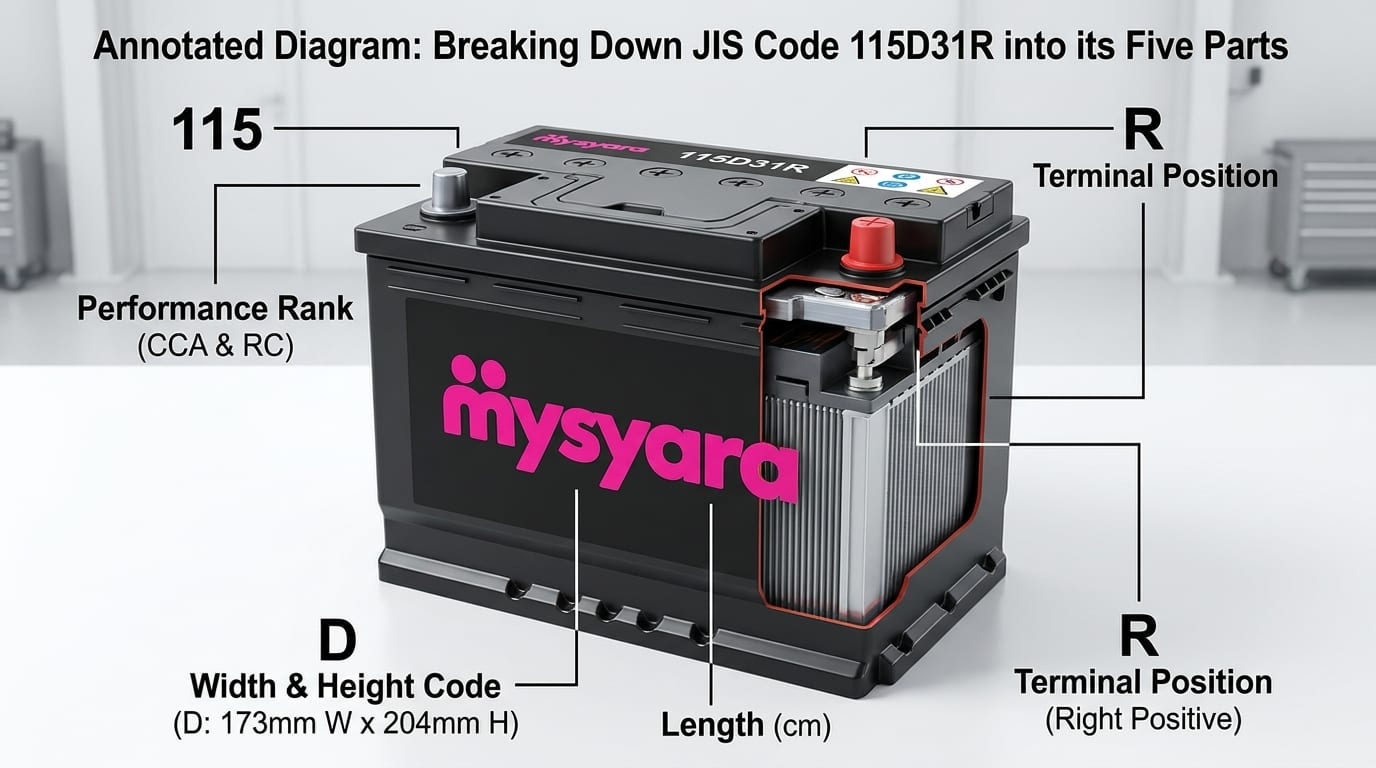
115D31R is a JIS-standard car battery code: 12-volt, performance index 115, D-class size (about 173 × 225 mm), 31 cm long, with the positive terminal on one short end. Match every part of the code on your old battery (the number, the letter, the length and the R or L) or the new battery won't fit, won't reach the cables, or won't crank the engine. The rest of this guide takes the three big code systems on cars sold across the UAE and the wider GCC (JIS, DIN and BCI), shows what each character means, and turns the labels into a "which one fits my car" answer. Car battery size codes explained for Gulf cars is the goal.
Key Takeaways
JIS, DIN and BCI are three different battery standards. A JIS 55D and a DIN 555 are not interchangeable, even at the same Ah.
The first number on a JIS code (115, 80, 55) is a performance index, not amp-hours. The actual Ah is on the spec sheet.
R or L tells you which short end the positive terminal sits on. Get this wrong and the cables won't reach.
In UAE heat, expect 18-24 months from a standard flooded battery, not the 3-5 years the maker prints on the side. The right group size and shaded parking matter more than oversizing.
Most Japanese and Korean cars in the UAE use JIS. European cars (BMW, Mercedes, Audi, VW) use DIN. American cars (Cadillac, GMC, Jeep, Ford) use BCI.
What the code on your battery actually is
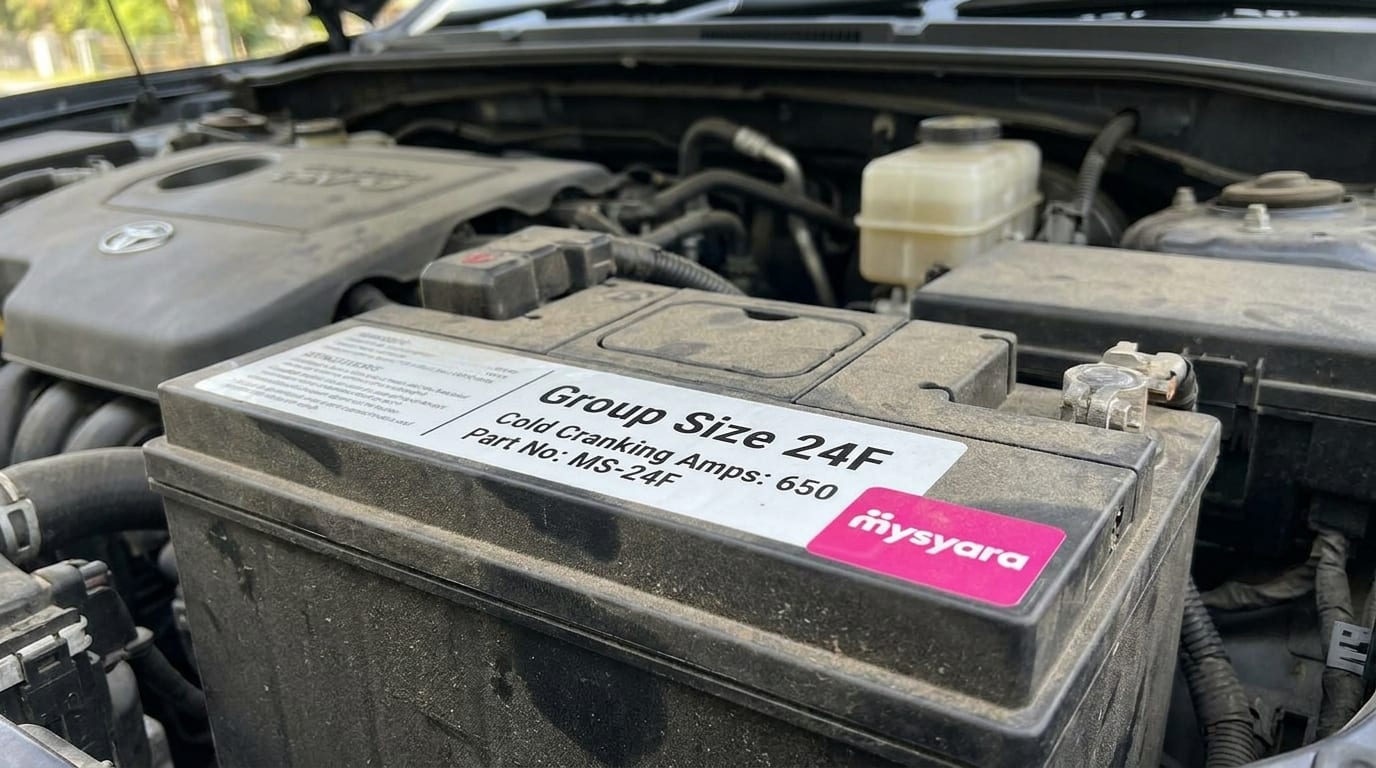
The string on the label (115D31R, 55B24LS, NX110-5LMF, H7 AGM 80Ah, BCI 65) is the battery's "group size" in one of three standards: the Japanese JIS, the German DIN (and its newer European ETN cousin), or the American BCI. Each standard codes for the same four things in a different way: physical dimensions, terminal position, terminal post size, and a performance figure that tells you roughly how much current the battery can deliver.
The standard your car uses depends on where the car was designed, not where it was sold. A Land Cruiser sold in Dubai still wears a JIS battery because Toyota designed the tray and clamp around JIS dimensions. A Mercedes C-class sold in Dubai still wears a DIN battery for the same reason. The original maker's standard is the one to match. Swapping standards mid-life means new clamps, new cable routing and, often, a tray that doesn't quite hold the new shape.
How to read a JIS battery code (115D31R, 55B24LS, NX110-5LMF)
JIS is the standard you'll see on most cars in the UAE: Toyota, Lexus, Nissan, Infiniti, Honda, Mitsubishi, Hyundai, Kia, Suzuki. A JIS code has five slots, in this order: performance index, width-and-height letter, length in cm, terminal side, optional terminal-size letter.
The first number: performance, not amp-hours
The 115 in 115D31R, the 55 in 55B24L, the 80 in 80D26L: this is the performance index. It combines cold-cranking ability and reserve capacity into a single figure; higher is more cranking and more reserve. It is not the amp-hour rating, even though it looks like one. The actual Ah (typically 60-100 Ah on passenger cars) is printed separately on the spec sheet.
The most common misread in UAE workshops is treating 115 as "115 Ah". The real Ah on a 115D31R is closer to 90 Ah, with cold-cranking amps around 750-850 depending on brand. Always cross-check the Ah and CCA on the actual product page, not on the code alone.
The letter: width and height class
B, D, E and so on are JIS classes for the cross-section of the battery, meaning the width by the height. B is roughly 129 × 203 mm. D is roughly 173 × 225 mm. E is roughly 176 × 213 mm. This is one of the two constraints to check against the battery tray: the wrong class won't sit flat.
The two-digit number: length in centimetres
The 24 in 55B24L means 240 mm long. The 31 in 115D31R means 310 mm long. This is the second tray-fit constraint. Together with the letter, length tells you whether the battery will physically drop into the slot.
R or L: terminal position
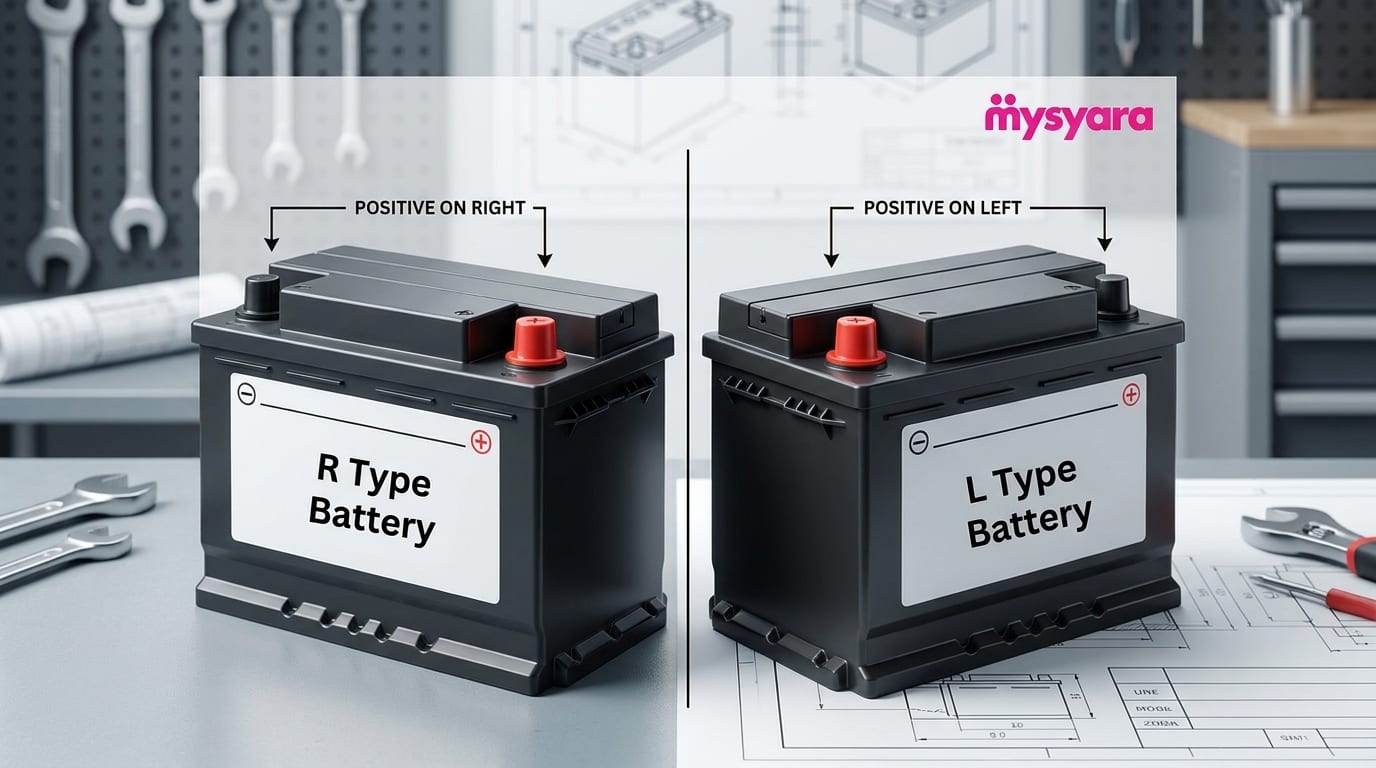
The letter at the end tells you which short end of the battery the positive terminal sits on, when you look at the long face with the terminals up. R = right end. L = left end. There's no Ah or performance trade-off between them; it's purely about which way the cable harness runs in your car.
Getting this wrong is the single most common ordering mistake. If the car needs 115D31R and you fit 115D31L, the cables either won't reach the posts or will reach across the case and short. Some sources describe R/L as the negative terminal side instead of the positive; the safe wording is "the positive sits on the side the letter says, when the long face faces you", verifiable against any battery photo on the product page.
That trailing S: terminal post size
A code like 55B24LS or 46B24LS adds an S at the end. The S means the terminal posts themselves are the larger "standard" diameter, fatter than the un-S version on the same code. The cable clamp on your car needs to match the post diameter. Most Hondas and some Toyotas use the larger S posts; the older Civic and most compact Hyundais use the smaller un-S posts. If your old battery had S, the new one needs S.
NX-prefix codes
NX110-5LMF, NX120-7 and similar are a JIS variant used for some maintenance-free batteries, common on newer Toyotas, Mitsubishis and Lexus. The decoding logic is similar (performance, size, polarity), the prefix just signals the format family and the MF at the end stands for "maintenance free". For fitment, treat them as JIS and match the full string.
How to read a DIN code (560, 574, 580) and the ETN beneath it
DIN is the standard you'll see on European cars: Mercedes, BMW, Audi, VW, Porsche, Range Rover. The case is shaped differently from JIS: DIN batteries have recessed terminals that sit slightly inside the top face, not posts that stick up. That alone means a DIN battery won't drop into a JIS tray and the other way round, even if the Ah on the label matches.
A DIN code is shorter than a JIS one. The first three digits give you the battery class:
The first digit is the voltage class. 5 = 12-volt battery under 100 Ah. 6 = 12-volt battery 100 Ah and above.
The next two digits give the nominal Ah. 560 is roughly 60 Ah. 574 is roughly 74 Ah. 580 is roughly 80 Ah.
Newer European batteries also carry a 9-digit ETN (European Type Number) underneath, for example 574 012 068. The first three digits are the DIN code; the rest encode performance class, terminal layout and CCA. For fitment, the first three digits are the ones that matter: match those and the rest of the spec (CCA, AGM-or-not) on the product page.
The two costly misreads on DIN:
DIN and JIS are not interchangeable at the same Ah. A JIS battery rated 60 Ah and a DIN battery rated 60 Ah are different physical cases with different terminal layouts. You can't swap one for the other.
Start-stop European cars need AGM. A standard flooded DIN in an AGM slot will short-cycle and fail in months. If your car has start-stop, the original was almost certainly AGM, and the replacement needs to be AGM too.
How to read a BCI / American group size (65, 94R, H7)
BCI is the Battery Council International standard, the American system. You'll see it on Cadillac, GMC, Jeep, Ford, Chrysler and Dodge. BCI uses a simple group number (35, 48, 65, 75, 94R) that maps to a physical box size. The number is the group; performance figures (CCA and Ah) are printed separately, not encoded into the group code.
Some European batteries carry both a DIN code and a BCI-equivalent group (H6 ≈ BCI 48, H7 ≈ BCI 94R). The European labelling crosses over because the EN 50342 standard, the European test standard that defines CCA at −18 °C, is the test method used on both DIN and BCI batteries sold in Europe. The number on the label is the cold-cranking amps a fully charged battery delivers for 30 seconds at −18 °C while holding above 7.2 V. The test exists; it just doesn't have much to do with UAE driving conditions, which is the next section.
Treat every row below as a starting point, not a guarantee. Year, trim, engine and whether the car came new through the UAE or via grey-market import all shift the answer. The two-minute check that beats any chart: read the label on the old battery, the exact code the car was built around.
Vehicle (UAE common)
Common group
Standard
UAE note
Toyota Land Cruiser 200 / Lexus LX
105D31L / 115D31L
JIS
High accessory load; the 115 gives margin for sustained AC.
Toyota Land Cruiser 300 (2022+)
105D31L / 115D31L
JIS
Same D31 JIS class as the 200-series; the 115 is the safer pick for sustained AC. Confirm against the label on the old battery.
Toyota Prado / Lexus GX
85D26L / 105D31L
JIS
Year-dependent.
Toyota Hilux
80D26L / 85D26L
JIS
Toyota Camry / Avalon
55D23L / 80D26L
JIS
Later models lean toward 80D26L.
Toyota Corolla / Yaris
46B24L / 55B24L
JIS
Nissan Patrol Y61 / Y62 (V8)
95D31R / 115D31R
JIS
V8 cranking; the 115D31R is the safer pick.
Nissan Sunny / Sentra
55B24L
JIS
Honda Civic / Accord
46B24LS / 55B24LS
JIS
Note the S. Honda uses the larger terminal posts.
Honda CR-V
55B24LS / 65B24LS
JIS
Mitsubishi Pajero
80D26L / 105D31L
JIS
Hyundai Tucson / Elantra
60B19L / 55B24LS
JIS
Mercedes C / E / S-class
H6 (≈ 580) / H7 (≈ 80 Ah)
DIN
Recessed terminals; AGM on most modern start-stop.
BMW 3-series / 5-series / X5
H7 (≈ 80 Ah) / H8 (≈ 92 Ah)
DIN, mostly AGM
AGM-required on most start-stop.
Audi A4 / A6 / Q5
H6 / H7
DIN, AGM where start-stop
Volkswagen Golf / Tiguan / Touareg
H5 / H6 / H8
DIN
Ford Edge / Explorer / Mustang
BCI 48 (H6) / BCI 65
BCI or DIN equivalent
Year-dependent.
Jeep Wrangler / Grand Cherokee
BCI 48 / BCI 94R
BCI
Cadillac Escalade / GMC Yukon
BCI 65
BCI
Infiniti QX56 / QX80
95D31R / 115D31R
JIS
Mechanically a Patrol, same battery.
If your car isn't on the list, the label still wins. A two-minute call to MySyara Shop with the code on the old battery (or a photo) gets a confirmed match before the order goes out.
A real scenario, on a real morning
It's 7:43 a.m. on the Sheikh Zayed Road shoulder. A 2018 Patrol clicked once and went silent. The owner, eight months into UAE summer, pops the bonnet, finds the battery, and reads 115D31R off the side label. He doesn't need to know what a "performance index" is to solve the problem; he needs three answers in the next ten minutes: (1) can he order one online and have it fitted today, (2) is the cheaper Amaron with the same code going to be a false economy in 45 °C, and (3) how does he stop the next one dying in 18 months.
The order side is the easy part: filter the battery category to 115D31R and pick a brand. The 18-month question is the interesting one, and it's why the UAE-heat caveat below matters more than any cranking-amp comparison.
Ah, CCA and reserve capacity: what to actually look at in UAE heat
Three numbers appear on most spec sheets. Treat them in this order.
Ah (amp-hours): how much energy the battery stores. A 60 Ah battery holds more than a 50 Ah one, all else equal. For a given group size, Ah is mostly fixed; you change it by moving up a group.
CCA (cold-cranking amps): how much current the battery delivers for 30 seconds at −18 °C while holding above 7.2 V. CCA matters in northern Europe and Canada. In the UAE, the battery is almost never below 25 °C; CCA is the wrong number to obsess over. A roughly correct CCA for the car is enough.
RC (reserve capacity): how many minutes the battery sustains a 25 A load before dropping under 10.5 V. RC is the number that matters in the UAE: short trips, idling with AC on, parked-in-sun discharge. All of those eat reserve. A higher-RC battery in the same group survives Gulf use longer.
Reserve capacity is often buried on the spec sheet under "RC" or "minutes". On Varta you'll see it as a separate column; on AC Delco it sits next to the CCA. If two batteries in the same group are close on price, pick the higher RC, not the higher CCA. Varta batteries publish RC consistently on their UAE-sold range; for JIS-format units, AC Delco lists RC on most product pages.
When you need AGM, not flooded
A standard battery is "flooded": the electrolyte is liquid sulphuric acid. AGM (absorbent glass mat) batteries hold the same electrolyte in a fibreglass mat, which lets them survive deep partial discharges and the constant micro-cycling that start-stop systems inflict. Most BMW, Mercedes, Audi and Range Rover models from roughly 2018 onward use AGM; many Lexus and Toyota hybrid models from 2020 onward use AGM; most cars with idle stop-start use AGM.
The rule on the workshop floor: if the old battery says AGM on the case, the new one needs to be AGM. A flooded battery in an AGM slot does not last; six to nine months is a common failure window. The price gap is real (AGM is usually 30-60 % more than a same-Ah flooded), but it's the wrong place to economise. We've flagged an /battery-type/agm page as a coming addition; for now, filter the batteries category by AGM to see what's stocked for your code.
How long a car battery actually lasts in the UAE
The brochure says three to five years. The Dubai summer says eighteen to twenty-four months. The compromise, for a standard flooded battery with normal city driving and outdoor parking, is roughly two years, two-and-a-half if you're careful. AGM units typically last a year longer. Multiple UAE retailers cite the same band; the Al Futtaim Trade Point summer-battery guide is the most plainly written.
Two follow-on points worth stating in writing:
Oversizing doesn't extend life in heat. Fitting a 115D31R where the car was specified for a 95D31R won't double the lifespan; the extra current capacity sits unused and the same heat-driven plate corrosion still happens. Match the spec, then look at brand and RC.
Shaded parking matters more than the brand premium. Park-in-sun temperatures on a black bonnet hit 65-70 °C on a summer afternoon. The same battery in covered parking lasts noticeably longer. Cooling matters more than 5 % more CCA.
FAQ
What does 115D31R mean on a battery?115D31R is the JIS code for a 12-volt battery with a performance index of 115, a D-class cross-section (about 173 × 225 mm), 31 cm long, with the positive terminal on the right short end. The matching Ah is around 90; the CCA is around 750-850 depending on brand. Common on UAE-spec Nissan Patrol V8s and Infiniti QX models.
Is 55B24L the same as 55B24LS?
No. The S means the terminal posts are the larger "standard" diameter, fatter than the no-S version on the same code. Honda and many newer Toyotas use the S posts; the cable clamp must match. If your old battery had S, the new one needs S.
Can I swap a JIS battery for a DIN battery if the Ah is the same?
No. JIS and DIN batteries have different case shapes and different terminal layouts (JIS has top posts, DIN has recessed terminals). Even at the same Ah, the new one won't sit in the tray or take the cables. Stay within the standard the car was built around.
My Land Cruiser is on a D31 battery. Which group is right?
Most 200-series and 300-series Land Cruisers in the UAE use a JIS D31 battery (105D31L or 115D31L). The choice between 105 and 115 is about reserve and cranking margin: 115 gives more headroom for sustained AC and accessory load, which is the right call for UAE driving. Always confirm with the label on the old battery.
What's the safest way to confirm the right battery for my car?
Read the label off the old battery and match the full code (the number, the letter, the length and the R or L, plus S if present). If the old battery isn't accessible, call MySyara Shop with the make, model and year, or book the fitment service, which includes the battery check.
Order, get it fitted, get back on the road
Browse the battery range at MySyara Shop once you've decoded the code on your label. If you would rather not do the swap yourself, the standard fitment service handles battery swaps from AED 25 at the workshop or kerbside; call +971 4 549 0333 to order the matching battery and book a mobile fitment slot. Whichever route fits the morning, the rule that doesn't bend is the one at the top of this guide: match the full code on the label.
Car battery size codes explained, in two sentences: read the label, match every character, and pick the right standard for the car. Everything else is brand and budget; in UAE heat, the brand matters less than where you park.
Free UAE delivery on orders over AED 200UAE fitment available from AED 25Genuine parts backed by warrantyShips worldwide from Sharjah